
 Nöbetçi Eczaneler




For generations, humanity’s impact on the planet has leaned heavily toward destruction rather than conservation. But what happens when our best intentions trigger an ecological catastrophe?
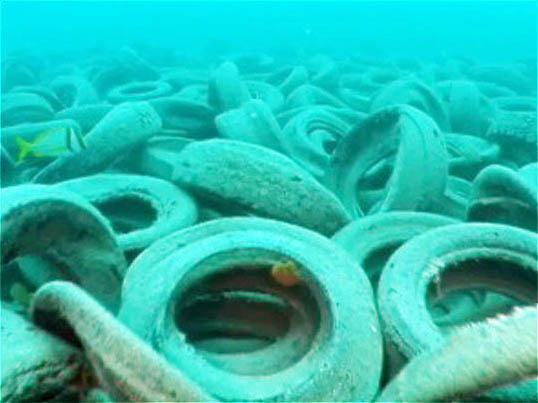
Just over half a century ago, an audacious experiment unfolded off the coast of Florida. In a bid to regenerate marine life, engineers submerged more than two million discarded tires, envisioning a thriving, man-made coral sanctuary. At the time, the project was celebrated as a brilliant stroke of environmental genius—a perfect solution to a growing waste problem.
Instead, it birthed a fifty-year underwater nightmare. Rather than shielding the ocean, this massive blunder began actively destroying it.
Back in 1972, a non-profit organization known as Broward Artificial Reef Inc. (BARINC) formulated an ambitious plan off the coast of Fort Lauderdale, Florida, designed to elegantly solve two environmental problems at once. The vision was straightforward: America was drowning in a massive surplus of discarded car tires, while Florida’s coastal marine life desperately needed new reef habitats to help declining fish populations recover. To achieve this, the execution involved submerging over two million old tires across a 36-acre expanse of the ocean floor to create a thriving artificial sanctuary. The initiative enjoyed massive institutional backing and high-level approval from the start; the U.S. Army Corps of Engineers officially greenlit the operation, the U.S. Navy provided heavy equipment to help deploy the payload, and the Goodyear Tire and Rubber Company enthusiastically sponsored the launch; even ceremonially tossing a gold-plated tire into the Atlantic to celebrate what everyone believed would be a historic environmental triumph.
The entire project rested on flawed assumptions about ocean dynamics and marine biology. It didn’t take long for three fundamental design failures to convert this environmental hope into an ecological catastrophe:
1. Structural Disintegration
Project organizers used steel brackets and nylon bands to lash the tires into dense bundles. However, they severely underestimated the destructive power of marine environments. The salt water quickly corroded the steel, and the nylon straps snapped under the pressure of the tides. Instead of a heavy, cohesive artificial mountain, millions of individual tires became loose and buoyant.
2. Deep-Sea Destruction
Without a anchoring mechanism, the tires were left at the mercy of the Atlantic’s fierce currents, tropical storms, and hurricanes. When major weather systems swept through, the ocean floor turned into a chaotic demolition derby. Massive underwater swells propelled thousands of heavy tires across the seabed, causing them to slam into healthy, native coral reefs, fracturing delicate ecosystems that had taken centuries to grow.
3. An Inhospitable Environment
The ultimate objective was for coral larvae to colonize the rubber surfaces, mimicking how they naturally inhabit sunken ships or concrete structures. But the chemical composition of rubber proved highly toxic to coral growth. Combined with the fact that the tires never stopped shifting in the current, any fragile marine life attempting to take root was instantly scraped away.
By the late 1980s, the initial optimism surrounding the project had completely evaporated, and the site was globally condemned as a catastrophic underwater wasteland. The true magnitude of this ecological failure became impossible to ignore when ocean currents began carrying the detached tires hundreds of miles away, causing them to wash ashore on the beaches of North Carolina. Fixing this half-century-old blunder has since evolved into an incredibly complex, multi-million-dollar salvage effort spanning several decades. A major breakthrough occurred in 2007 when the Pentagon initiated “Operation Tire Reef,” a joint venture that transformed the environmental crisis into a real-world training ground for U.S. Army and Navy salvage divers to haul up hundreds of thousands of tires. Alongside the military, independent non-profits and private eco-coalitions, such as the ocean cleanup company 4ocean, have deployed specialized recovery boats and commercial diving teams to help reclaim the seafloor. Despite these monumental efforts, a massive task still lies ahead; hundreds of thousands of tires remain embedded in the marine environment, prompting the state of Florida to secure active cleanup funding and extraction contracts that stretch through 2032. Compounding the tragedy is the bittersweet reality of the final disposal process: because these tires have degraded after decades underwater, they cannot be recycled into new retail products and must instead be trucked inland, shredded, and burned as a supplemental fuel source for industrial manufacturing facilities.
By the end of the 1980s, the project was recognized globally as a catastrophic mistake; a literal underwater wasteland. The scale of the failure became undeniable when loose tires began washing ashore on beaches hundreds of miles away in North Carolina.
It is believed that 500,000 tires are still underwater today.
THE SCUBA NEWS Link !
DemirHindiSG
06 Temmuz 2026-12:57
