
 Nöbetçi Eczaneler




Richard Aspinall explores the rich life of Jacques Cousteau’s ‘most beautiful island in the world’ during an unforgettable trip on board the Cocos Island Aggressor
Words and pictures by Richard Aspinall
Ask any biologist why islands are special and they will talk about geographic isolation and endemic species, Charles Darwin and natural selection. Islands are oases of life amid empty ocean expanses, where evolution takes its own unique directions.
Divers love islands too, and of all those that are available to us to enjoy, Isla del Coco – or simply Cocos – offers some of the greatest wildlife spectacles on Earth. Jacques-Yves Cousteau described it as ‘the most beautiful island in the world,’ and who are we to disagree?
Cocos lies 547 km (340 miles) off the Pacific coast of Costa Rica, one of a series of volcanic seamounts that stretches south to the Galápagos Islands. It sits at the heart of a National Park of more than 200,000 hectares, a UNESCO World Heritage Site where fishing is banned, and – unlike many other marine protected areas – where the rules are enforced.
It is remote, isolated, and save for a few researchers and rangers, uninhabited. Some of its perilously steep valleys are still unexplored and, as a nineteenth-century pirate haunt, there is a chance, albeit remote, of finding undiscovered treasure.
The journey to Cocos from the port of Puntarenas in Costa Rica takes 36 hours and can be rough – seasickness medication is advised for those who are sensitive – but it is worth it to wake in Chatham Bay to the sight of lush and verdant tropical rainforest, a sky wheeling with seabirds, and the sea alive with fish breaking the surface, hinting at an underwater world just as rich and complex.

After several days of travel, the 22 divers on board were eager to be in the water, and after a comprehensive safety briefing we kitted up for our check dive. Diving from the Cocos Island Aggressor is exclusively from large RIBs, called ‘pangas’, each carrying ten to twelve divers.
The guides and boat handlers help with our gear, which remains on the panga between dives as the tanks are filled using long hoses from the mothership.
I had little idea what to expect before we back-rolled into the warm water of a site known as Coral Garden for our check dive. My first impression was fish – lots of them – and current.
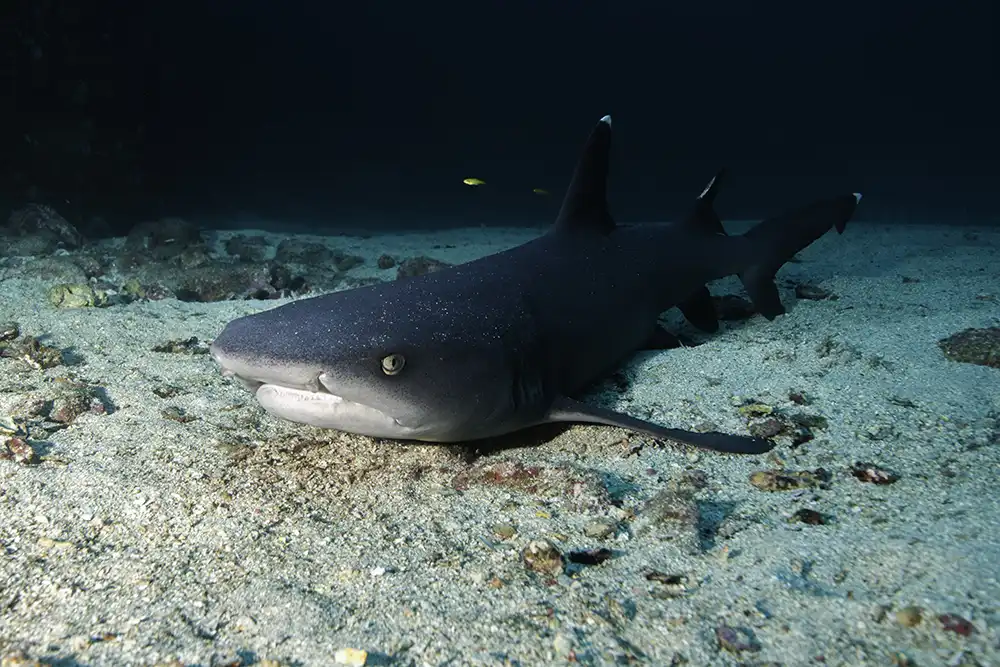
Scores of whitetip reef sharks rested up on sandy patches and snappers shoaled in their hundreds while king angelfish and Moorish idols nipped away at morsels of food on the rocks.
In just minutes I had seen more sharks than in the last few years of diving combined, but while this was a great dive, what we were really after was hammerheads.
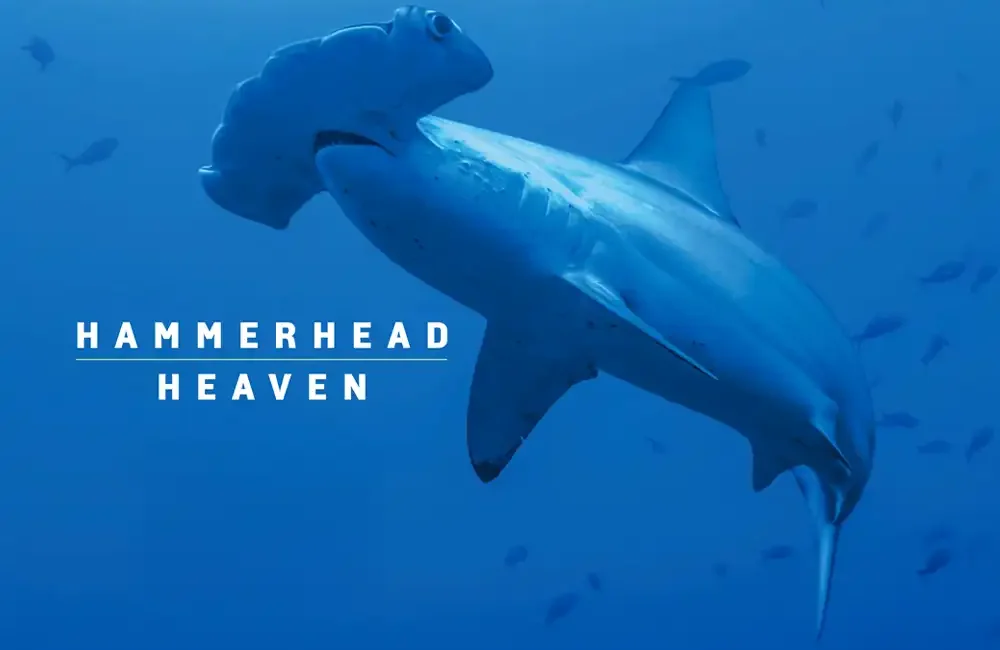
Hammerheaven

Scalloped hammerheads (Sphyrna lewini) are drawn to Cocos in their hundreds, following the seamounts of the blue corridor from Galápagos and Malpelo Island. Cocos is one of the few locations on Earth where you can dive with them in such numbers.
The sharks spend much of their time in the blue but visit the reefs for the services of the barberfish – also known as blacknosed butterflyfish (Johnrandallia nigrirostris) – which gather at cleaning stations to flock around the sharks (and other fish) to pick away at parasites and old wounds.
Many of the females have wounds that indicate rough courtship and mating have recently taken place.
Manuelita Island, a steep-sided volcanic rock surrounded by car-sized boulders, offers three amazing shark dives, and we would spend a good chunk of our week around its flanks.
The dive plan calls for a negative entry and a quick descent to avoid the currents, before we rendezvous at around 20 metres (66ft) and head for the cleaning station at 30m (98ft) to hunker down among the rocks.

This is not a trip for novices. Cocos demands confidence and the ability to deal with currents – every diver is given a GPS locator, just in case.
With a heavy plankton load in the water, visibility was not great (it varies with the season), but we could see the barberfish and, within minutes, half a dozen hammerheads approached.
I fired off a few shots with my camera and quickly learned that strobes spook the sharks. I’d not be winning any friends if I scared these skittish fish away, so decided to shoot on ambient light only.
The hammers approached the large rocks where, by some ancient fishy agreement, they would meet the barberfish. Arching their backs and appearing to relish the cleaners’ attentions, the sharks were astonishing to watch; such powerful animals, yet so sensitive to the world around them.
At the same time, large marble rays passed by, a manta provided a silhouette in the surface waters above, and whitetip reef sharks littered the floor.
We had to remember to watch our depth and dive time carefully, but for my first dive with scalloped hammerheads, I could not have been happier.
Cocos owes its rich biodiversity to its location, geography, and a convergence of nutrient-rich currents which, further cycled between land and water, maintain a foundational planktonic food web that feeds fish in their millions.
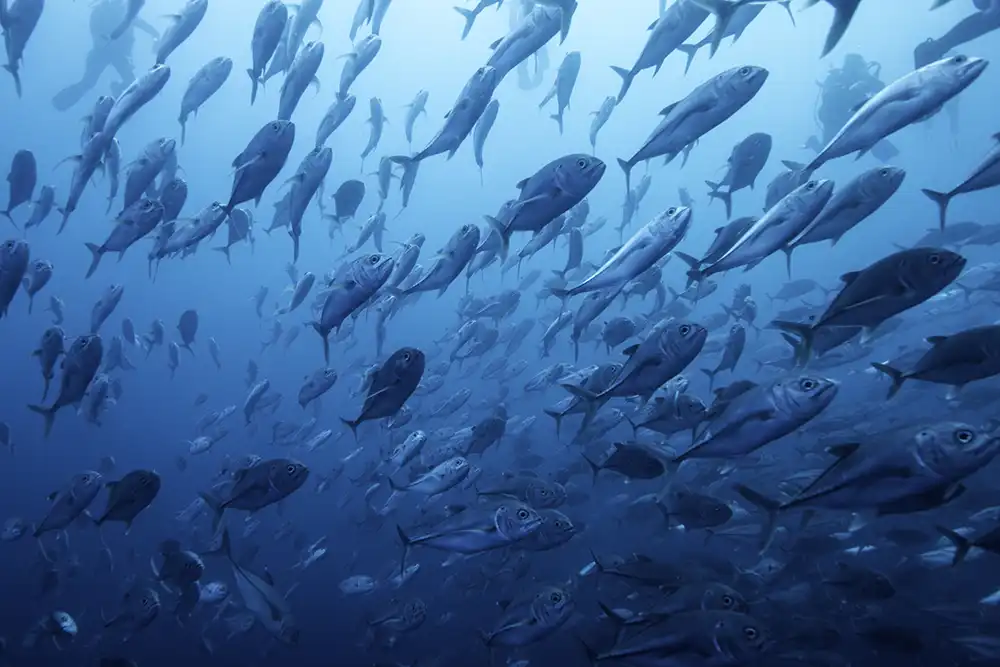
Nowhere was this more evident than the channel between Manuelita and Cocos, where huge shoals of jacks would congregate, so dense and large they mimicked the sea mounts themselves.
Briefly, what we took to be a school of fish revealed itself to be a whale shark passing above, enjoying the plankton-rich waters.
Jurassic Diving

Offering a slightly different experience to Manuelita is Submerged Rock, on the other side of the island to the northerly Chatham Bay.
Used for the aerial shots in Steven Spielberg’s Jurassic Park, Submerged Rock is a ten-minute ride by panga, offering divers the chance to see more of the island’s spectacular scenery en route.
As the name suggests, the site is a large seamount that fails to break the surface, bathed in currents which can occasionally be strong, but not so much of an issue as most dives were drift dives.
The site’s shallow plateau was filled with whitetips, resting and being attended to by small and colourful island cleaner blennies. Not for the first time did I wish I could switch between wide-angle and macro while underwater.
However, I had a 16-30mm zoom lens fitted and it worked well, allowing me further ‘reach’ with the hammers – which were passing by once more.
Submerged Rock is also noted for a fantastic swim-through, so full of fish it is at first hidden, then exhilarating as the current shoots you through to the other side.
Nearby Alcyone was one of Cousteau’s favourite dive sites in all the world, and was named for his experimental ‘turbosail’ vessel.
Our first visit was in torrential tropical rain – this is one of the wettest places on Earth after all – where Warren, our guide and cruise director, took us down a buoy line to the mount below.
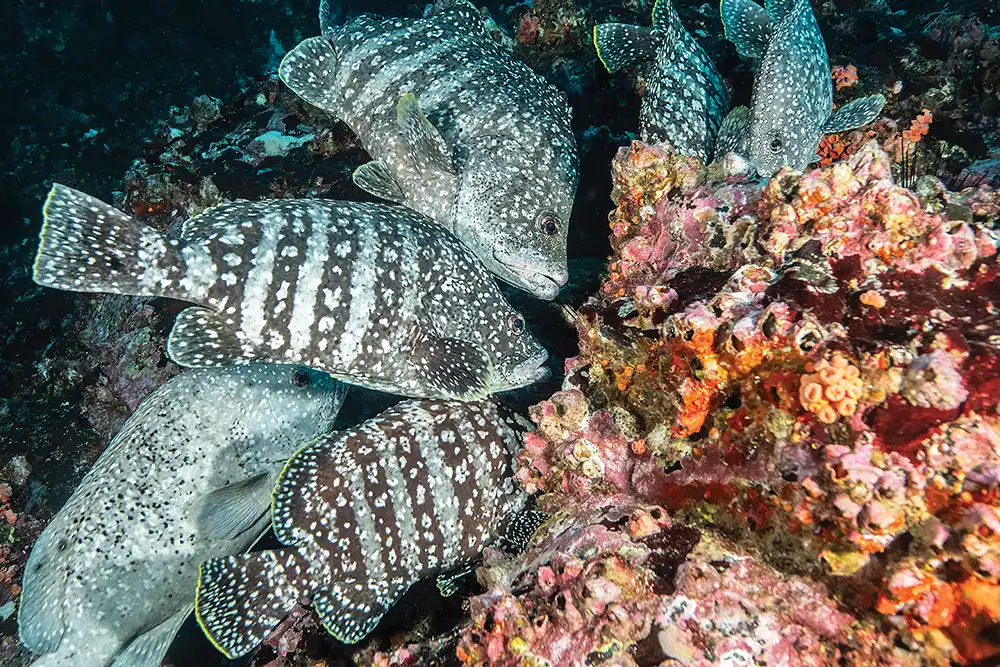
Visibility was much better, although a good torch brings out the bright pink colours of the barnacle- and algae-covered rocks, home to little blennies and a good number of long-spined urchins, which reminded us not to be complacent about our buoyancy.
It is no wonder Cousteau loved Alcyone. I happily shot away at fish that were almost tame, from leather bass to giant hawkfish, while snapper, rainbow runners and a massive shoal of jacks competed for our attention.
At one point, a dolphin made a high-speed pass, picking a prize from the throng of fish.
Once more we were joined by hammerheads at a cleaning station below, and two Galápagos reef sharks and a blacktip cruised by before we had to ascend.
We returned to Alcyone several times and settled again into the comfortable rhythm of ‘get down, watch the sharks, and enjoy the spectacle’, before ascending slowly from the rocks into the blue, keeping together as a group.
Most of the time we enjoyed the large numbers of snappers, grunts, jacks and trevallies, but on two special occasions we saw a wall of hammerheads, keeping their distance but creating an iconic spectacle.
On one ascent we caught a fleeting glimpse of a sailfish, more than a metre long, as it passed us by.
More Than Just Sharks

The biologist in me was eager to explore the other habitats Cocos offers, so when the chance came to land on the beach at Chatham Bay, I could not have been happier.
The island is covered in dense tropical rainforest, every tree clothed in ferns, mosses and bromeliads. A river and waterfall attracted folks who wanted a swim, but I wanted to find some bird life.
I managed to photograph some local lizards before bagging a shot of the Cocos Island finch, an endemic relative of Darwin’s Galápagos finches.
A muddy trek up the hill provided spectacular views across the bay to see Cocos Island Aggressor moored up in the sunshine; the rainforest behind lush with tendrils of cloud reaching into the valleys.
Our time on the island was brief and, after posing at Cousteau Rock, we headed back out.
It is hard to imagine, but sharks were so commonplace that encounters became unremarkable. In just one dive in Cocos, I had seen more hammerheads than I’d previously seen in more than 20 years of diving.
On a Red Sea trip just weeks before, I’d been ecstatic to see just one whitetip reef shark, yet here they were almost ignored in their ubiquity.
I was keen to photograph other local oddities underwater, so I switched to a macro lens hoping to find some frogfish.
A dive at Coral Garden proved fruitless, but our excellent guide Eduardo discovered a mantis shrimp, snowflake moray, endemic Cocos triplefin and a rare barnacle blenny instead.
The frogfish would eventually turn up during an intriguing dive at Lobster Rock, a flat site with seagrass, sand (and yes, lobsters) and, finally, a bright orange frogfish resting up in a rhodolith field.

Rhodoliths are free-living nodules of calcareous red algae, which grow in layers to form large patches of pink, potato-sized structures.
I could have spent a week exploring this one site alone, but by now I had photographed a good assortment of the island’s residents and visitors alike, and my memory cards were full.
The large, capable and comfortable Cocos Island Aggressor was a joy to be aboard. The well-equipped camera and charging areas were very welcome; the cabins were roomy and well-appointed and the food exceptional.
We enjoyed three dives per day at the sites already mentioned, plus Dirty Rock, Small Dos Amigos, and Punta Maria, and sharks were present on every single dive.
It’s easy to run out of superlatives when describing Cocos Island. It is without question the finest location I have ever dived.
It is a biological and cultural wonder and I cannot disagree with Cousteau. I thought it to be, in every way, the most beautiful island on Earth, both above and below the surface, and a trip aboard Cocos Island Aggressor is one of the finest liveaboard experiences available.
If Cocos is not on your destination list, then it should be. Pura Vida Cocos!
For more information about diving Cocos Island and available itineraries, head to www.aggressor.com
More great reads from our magazine
- Neighbours of the North Wall – life among Sund Rock’s wolf eels
- My Octopus Mother – a life-changing encounter in the Emerald Sea
- Making a splash – a judge’s eye view of the Dive Dauin photo splash-in
- The old man, the sea, and the son – a father and son’s diving journey to Galápagos
- Full Circle – Crowley’s return journey through 25 years of Sharm El Sheikh

Take out a year’s print and digital subscription from £23.99
(UK price, international postage extra)
The post Hammerhead Heaven – on board the Cocos Island Aggressor appeared first on DIVE Magazine.
