
 Nöbetçi Eczaneler





The Galápagos Islands are entering what could become one of the most significant El Niño events of the modern era, and beneath the surface, some of the changes appear to have already begun.
For divers, that does not mean the Galápagos has suddenly stopped being one of the world’s great underwater destinations. It does mean that the conditions traditionally associated with particular islands and seasons may become considerably less predictable over the coming months.
The latest outlook from the NOAA Climate Prediction Center is striking.
In its September 10 update, NOAA said El Niño was continuing to strengthen, with more than a 90% chance of a very strong event during the Northern Hemisphere autumn and winter of 2026-27.
More significantly, NOAA now puts the probability of the event reaching historic strength during October to December at 75%, potentially exceeding previous El Niño events in records dating back to 1950.
For the Galápagos, sitting directly in the eastern equatorial Pacific, this is far more than a distant climate forecast.
It is something dive crews are beginning to see underwater.
The Water Is Already Unusually Warm
The Scuba News contacted operators working in the Galápagos to find out whether the developing El Niño could already be detected in day-to-day diving conditions.
Megan White, Adventure Planner for Galapagos Aggressor III, spoke with the vessel’s Cruise Director, Stefan, who provided The Scuba News with observations from recent weeks aboard the liveaboard.
His assessment was straightforward: conditions are considerably warmer than they should be at this point in the year.
Recent water temperatures reported from the vessel have been approximately 77°F to 82°F around the central islands and 80°F to 83°F around the northern islands.
Even in the normally colder western islands, Stefan reported surface temperatures around 76°F, falling to approximately 73°F at depth.
At this time of year, those western waters would normally be considerably colder.
The crew has sometimes encountered no significant thermocline at all.
That matters because the remarkable abundance of life encountered by divers in the Galápagos is closely connected to the meeting of different ocean currents, including the arrival of cold, nutrient-rich water.
Warm water by itself is only part of the story.
Why The Cold Water Matters
The Charles Darwin Foundation says the cold waters reaching the Galápagos transport nutrients that support phytoplankton, which in turn forms the foundation of much of the marine food web.
As El Niño warms the ocean and reduces the influence of nutrient-rich water, marine productivity can decline.
The effects then work their way through the ecosystem.
Small organisms and fish have less food available. Larger animals dependent upon them can subsequently face the same problem.
María José Barragán, Science Director at the Charles Darwin Foundation, has warned that warmer water reduces primary productivity, with consequences potentially emerging weeks or months after the initial oceanographic changes.
Penguins, flightless cormorants, marine iguanas, sea lions and predatory fish are among the animals dependent on that productivity.
And aboard Galapagos Aggressor III, there are already some intriguing observations.
Where Have The Sharks Gone?
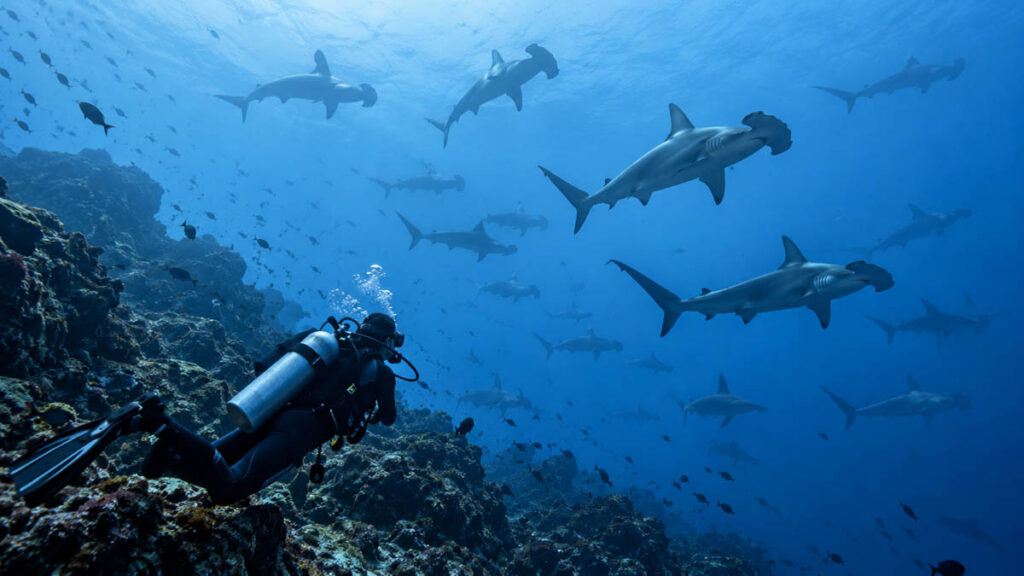
At Darwin Island, Stefan reported markedly reduced shark activity during recent trips.
In some recent weeks, the crew recorded no hammerhead shark sightings and no Galápagos shark sightings at Darwin.
At Wolf Island, the picture has been somewhat better. Hammerheads and Galápagos sharks are still being encountered, but activity has been below what the crew would normally expect.
Perhaps most notable is another absence.
The crew told The Scuba News that they are currently missing the whale sharks normally associated with the northern islands at this time of year.
That does not establish that El Niño alone is responsible for individual sightings or absences. Wildlife encounters in the Galápagos can vary considerably from week to week, something Stefan himself was careful to stress.
But when the observations are considered alongside unusually warm water and the broader changes now being recorded across the eastern Pacific, they provide a valuable real-world snapshot of an ecosystem entering unusual conditions.
The Western Islands Are Changing Too
The western islands of Fernandina and Isabela provide another important clue.
These waters are normally among the coldest and most productive encountered on a Galápagos itinerary.
Stefan told The Scuba News that recent trips have seen less marine iguana activity and no mola mola sightings.
Marine iguanas are particularly significant.
The Charles Darwin Foundation describes them as useful indicators of changing ocean conditions because their survival is closely connected to the availability of algae.
When warming water reduces their food supply, the animals can lose weight. During severe historical El Niño events, mortality can become substantial.
The Foundation notes that the presence or absence of marine iguanas can therefore reveal changes taking place in the surrounding ocean.
It Is Not An Empty Ocean
There is an important distinction here.
None of this means that diving in the Galápagos has become devoid of marine life.
Far from it.
Galapagos Aggressor III is still reporting tropical fish, large schools of bigeye jacks and black-striped salemas, rays, eels, lobsters, Pacific green turtles, sea lions, fur seals, dolphins, penguins, flightless cormorants and seahorses.
Visibility has generally remained good, while currents have often been relatively gentle, becoming stronger at times around Wolf Island.
Surface conditions have been rougher, particularly around the northern and western islands, while the weather has generally remained sunny and unusually mild.
The important difference is the composition and abundance of the wildlife.
As Stefan put it, there is still always something to see. What has changed is that the amount and type of wildlife being encountered is not necessarily what crews would normally expect for the season.
For divers considering a Galápagos trip, that distinction matters.
What Happens Next Could Matter More
El Niño is not yet at its projected peak.
NOAA reported on September 10 that sea surface temperature anomalies had exceeded 3°C across parts of the eastern equatorial Pacific. The agency expects the event to continue strengthening through the end of 2026.
There is therefore a considerable difference between what divers are seeing now and what the ecosystem may experience if those forecasts materialise.
The Charles Darwin Foundation says some of the first signals are likely to appear in ocean conditions and food availability. Changes in animal behaviour, reproduction and distribution may emerge later.
Some consequences might not become fully apparent until after the warmest water has passed.
That is particularly concerning for animals that cannot simply move elsewhere.
Corals Could Face The Greatest Pressure
Corals are among the ecosystems being watched particularly closely.
Unlike sharks, fish or marine mammals, coral colonies cannot relocate when conditions deteriorate.
The Charles Darwin Foundation says Galápagos corals suffered an estimated 97% mortality during the severe 1982-83 El Niño. The 1997-98 event then interrupted their recovery further and contributed to local extinctions.
The historical record therefore provides a sobering indication of what prolonged extreme warming can do.
Recent research is adding another layer of concern.
Scientists studying Galápagos corals have found evidence suggesting that modern El Niño events are becoming more extreme than those experienced across much of the previous millennium.
Exactly how the developing 2026 event ultimately compares will only become clear with time.
The Wider Wildlife Impact
The concern extends far beyond the animals divers typically travel to see.
Scientists quoted by the Associated Press have warned that Galápagos penguins, blue-footed boobies, petrels, flightless cormorants, albatrosses and sea lions could all face pressure if food availability falls sharply.
Gustavo Jiménez of the Charles Darwin Foundation told AP that when sufficient food disappears, colonies can stop reproducing, disperse in search of food and suffer increased mortality.
The Galápagos has seen this before.
Following the powerful 1997-98 El Niño, the Galápagos penguin population suffered a dramatic decline. That history is one reason researchers are watching the developing event so closely.
So Should Divers Still Visit The Galápagos?
There is currently no evidence to suggest divers should abandon plans to visit the islands.
But expectations may need to change.
The conventional Galápagos diving calendar is built around relatively predictable seasonal oceanographic patterns. Cooler, nutrient-rich conditions traditionally bring particular species and behaviours, while the warmer season produces another set of encounters.
A powerful El Niño can disrupt that pattern.
A diver travelling specifically for whale sharks, large hammerhead aggregations or mola mola should therefore understand that historical seasonal expectations may be less reliable during the coming months.
Conversely, warmer water and altered currents can create different encounters and distributions that are much harder to predict.
That uncertainty is part of the story.
The Galápagos remains a wild ocean environment, not an aquarium whose inhabitants appear according to a timetable.
A Rare Opportunity To Watch An Ocean Change
There is another reason the coming months deserve attention.
Few diving destinations provide such a visible connection between large-scale oceanography and individual animals.
Changes beginning thousands of kilometres across the Pacific can ultimately determine whether a diver at Darwin sees hundreds of hammerheads, whether whale sharks arrive, whether marine iguanas can find sufficient algae, or whether a penguin successfully raises its young.
For scientists, decades of monitoring in the Galápagos provide an extraordinary record against which the 2026 event can be measured.
For divers, dive guides and liveaboard crews, the changes may be witnessed one dive at a time.
The Scuba News has also contacted the Charles Darwin Foundation directly for further comment from its marine scientists and local dive guides. We will continue following conditions in the islands and update this feature as further observations and scientific data become available.
For now, perhaps the most important message is not that El Niño will make Galápagos diving “better” or “worse”.
It is that the ocean is changing.
And some of those changes are already visible beneath the surface.
THE SCUBA NEWS Link !
DemirHindiSG
16 Eylül 2026-12:12
