
 Nöbetçi Eczaneler





The largest seagrass restoration project ever undertaken in the UK has been launched as part of a £1.8 million marine recovery programme in Cornwall.
Named ‘Mor Nature’, using the Cornish word for ‘sea’, the three-year project will restore 10 hectares of seagrass meadow in Falmouth Bay and native oyster populations across the Fal and Helford Special Areas of Conservation through habitat restoration, monitoring and community stewardship.
Led by the Ocean Conservation Trust (OCT) and Cornwall Wildlife Trust (CWT), Mor Nature is backed by £1.4 million from the UK government’s Department for Environment, Food & Rural Affairs (Defra) Species Recovery Programme, alongside additional funding partners.
The programme also supports the government’s Wild Again: Restoring England’s Wildlife campaign and is expected to contribute towards government targets to increase seagrass by 15 per cent compared with 2024 levels by 2043.

The restoration site stretches between Swanpool and Pendennis Castle in Falmouth Bay, where OCT introduced Sensitive Habitat Marker Buoys and voluntary no-anchor zones in 2022.
The project builds on CWT’s work mapping and monitoring existing seagrass meadows, expands its network of intertidal restoration sites, and will establish new oyster nurseries in the Helford with local fishers and community groups.
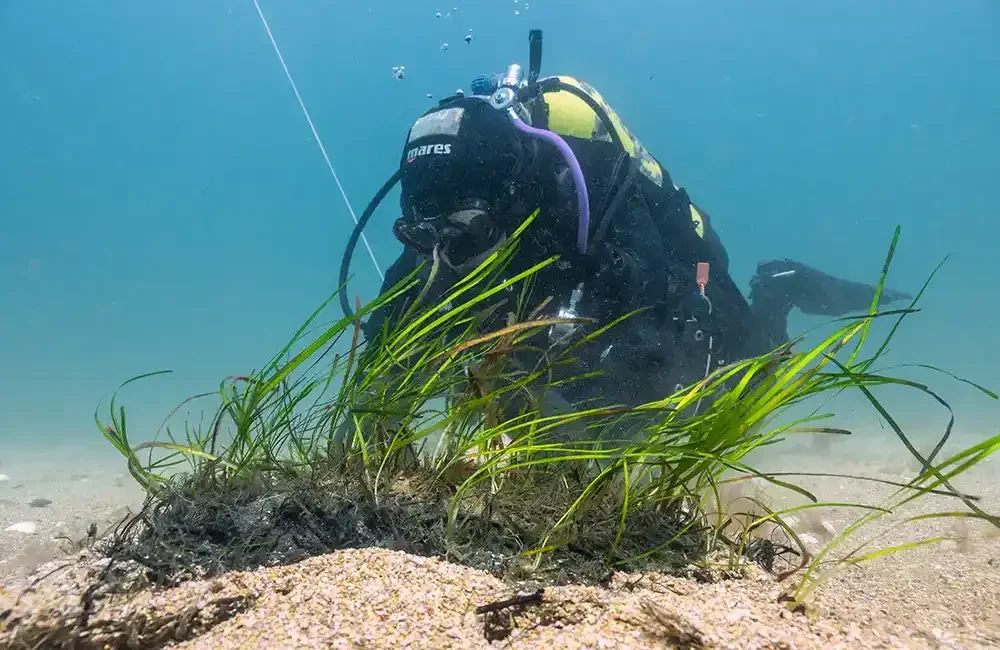
Over the past winter, OCT cultivated more than 21,000 seagrass seedlings at its National Seagrass Nursery. These will be transplanted into the restoration site alongside thousands of additional seeds deployed using restoration technology developed by the charity.
The work requires months of cultivation, specialist logistics, vessel operations and underwater installation by trained divers while working around tides, weather and underwater visibility.

To relieve the future burden on human divers, OCT has also been working with partners through an initiative known as Project AMPERES, which will trial automated and robotic restoration technologies.
The ‘Meadow Maker’ and ‘Automatic Seagrass Planter’ will be tested on a small area of the meadow, while specialist divers will plant the vast majority of the 10-hectare site.
‘Mor Nature represents a major milestone for marine restoration in the UK,’ said Andy Cameron, Conservation Project Manager at the Ocean Conservation Trust.

‘We’re not simply planting seagrass; Mor Nature represents the holistic cultivation of an entire underwater garden, nurturing the relationships between interdependent species and habitats that will allow a plethora of marine life to thrive.
‘We’re helping to rebuild an interconnected marine ecosystem that supports wildlife, strengthens coastal resilience and delivers benefits for local communities.
‘This project demonstrates what is possible when conservation organisations, local communities, government and industry work together to restore nature at scale.’
Restoring seagrass and native oyster habitats will support species including seahorses, spider crabs, cuttlefish, bass and sharks, which rely on seagrass meadows for food and shelter – many species of fish use seagrass as nurseries for their offspring.

‘Native oysters were once a defining feature of Cornwall’s seas, creating thriving underwater habitats that supported wildlife, fisheries and coastal communities,’ said Dr Dan Barrios-O’Neill, Head of Marine Conservation at Cornwall Wildlife Trust.
‘Through Mor Nature, we have an opportunity to restore not only oyster populations, but the ecological functions they provide.
‘Cornwall Wildlife Trust is leading the native oyster restoration and intertidal seagrass restoration elements of the project, building on our community-first approach, working with local fishers, our ‘Your Shore’ community group network, and citizen scientists to restore our seas.’
The project will also engage local communities through citizen science projects, snorkel safaris and educational events.
For more information – or to get involved – visit www.oceanconservationtrust.org or www.cornwallwildlifetrust.org.uk. You can follow Cornwall Wildlife Trust on Facebook, Instagram and LinkedIn to keep up-to-date with projects, events and news.
Related articles
- Success for England’s largest seagrass restoration project
- New boat mooring system sees seagrass meadows bloom
- Blue Grass – the seagrass meadows of Orkney
- More eco-moorings for Studland Bay seagrass meadows
The post UK’s largest-ever seagrass restoration project begins in Cornwall appeared first on DIVE Magazine.
