
 Nöbetçi Eczaneler





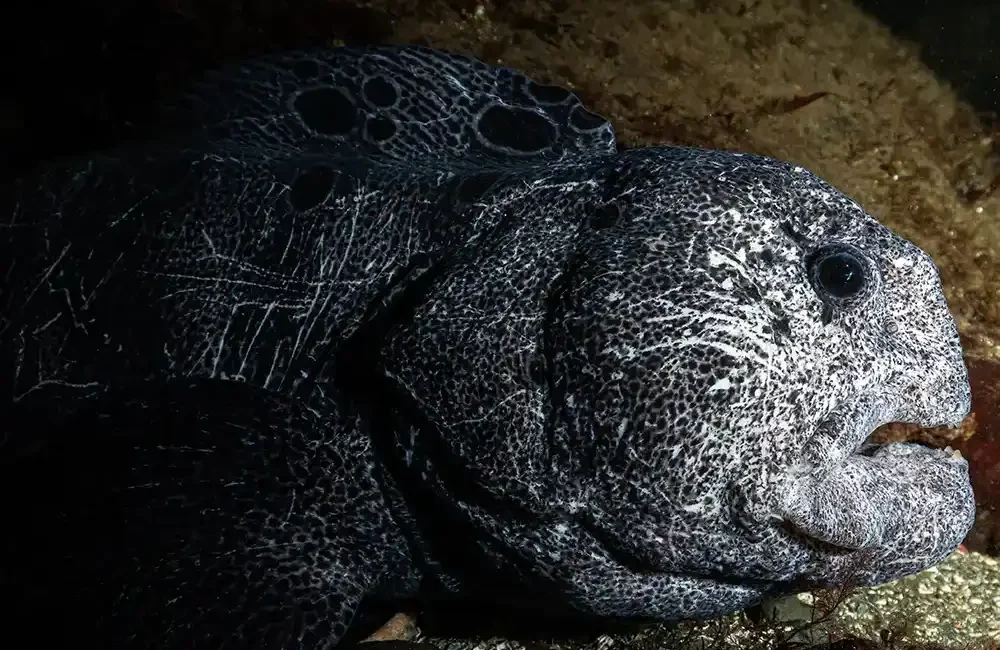
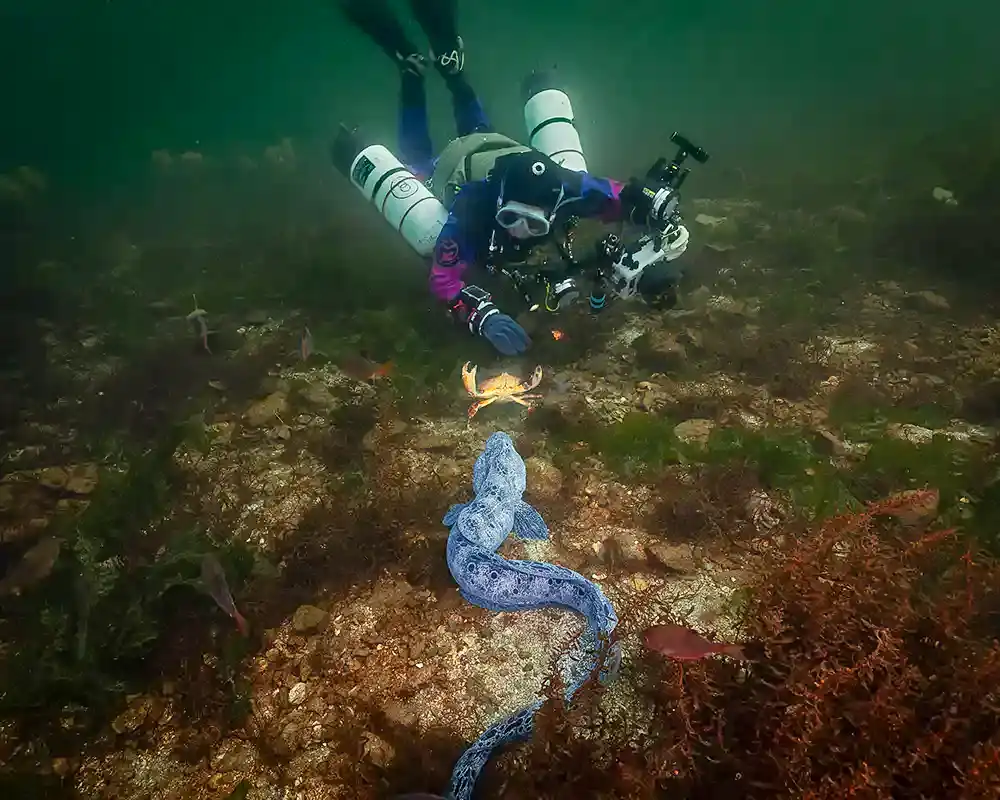
Not wolves, not eels, not dangerous – wolf eels are some of the Pacific Northwest’s homeliest, but most charismatic fish. Seattle-based marine biologist and underwater photographer Isabella Zandoná introduces us to her friendly neighbourhood wolfies
Words and pictures by Isabella Zandoná
Tucked along the shoreline of Hood Canal in Washington state, the north wall of the dive site known as Sund Rock is one of the Pacific Northwest’s most iconic shore dives.
The surface swim to the buoy feels endless in the chilly water, the weight of my gear pulling against me. The buoy is encrusted with barnacles and algae, marking the drop that will deposit us onto the north wall, nearly 21 metres (70 feet) below the surface.
I place my regulator in my mouth, and adrenaline starts pumping as the cold water, a sharp 8 degrees Celsius (48ºF), hits my face as my buddy and I begin our descent.
Equalising our ears with each metre, the hiss of our inflating drysuits surrounds us and the steady soundtrack of our breathing calms me down in the low visibility.
For the longest time, there’s no ocean floor in sight, then, as if emerging from fog, the boulder wall becomes visible beneath us. I prep my camera, knowing that Sund Rock always delivers to photographers, and, for this dive, my focus will be on one of its most famous residents – the wolf eels.
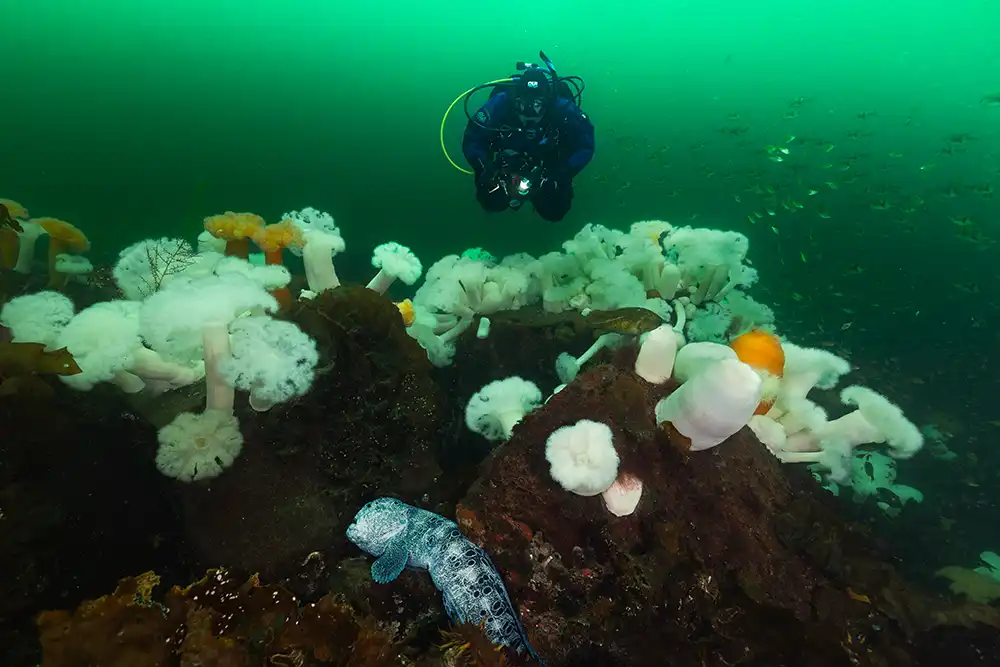
Sund Rock isn’t just a dive site, it’s a piece of local Washington history. Homesteaded by Colbein John and Bertha Sund in the late 19th century, before Washington achieved its statehood, the land has remained in the family for generations.
The site was discovered by scuba divers in the early 1960s, and quickly became a favourite due to its unique underwater terrain and very abundant marine life.
Unfortunately, early visitors were not always mindful, with some divers overharvesting lingcod, rockfish, and differing types of crabs, while others left behind debris.
Recognising the need for conservation, the Sund family collaborated with the University of Washington to make Sund Rock a protected marine preserve. Today, access is limited to respectful divers who pay a fee to enter the private marine preserve.
This has ensured that the dive site and its inhabitants are preserved and that the land is well looked after; Sund Rock’s history serves as a reminder that exploring the ocean comes with responsibility.
We reach the bottom of the north wall, where a boulder field stretches out in front of us. The boulders create ideal dens for the native Sund Rock residents, from giant Pacific octopuses to the unique wolf eels and little nudibranchs, often thought of as a tropical family of molluscs.
Like Sund Rock, wolf eels (Anarrhichthys ocellatus) are themselves a storied species, held in deep respect by the Indigenous peoples of the Pacific Northwest.
Wolf eels are edible fish but were also seen as symbols of strength and resilience. In some Native Alaskan cultures, they were known as mukah, or ‘doctor fish’, and only the shamans or healers were allowed to eat their flesh, in the belief that it would enhance their healing powers.
The Real Eel
Despite the name, wolf eels are not actually eels but part of the small family of wolf fishes (Anarhichadidae), of which there are two genera and five species, all confined to the cold waters of the northern Pacific and Atlantic Oceans.
Wolf eels are unique to the North Pacific, ranging from Alaska as far south as Baja California, although they are most commonly encountered in the cold waters of the Pacific Northwest and British Columbia.
Like other wolf fishes, they have elongated bodies and powerful jaws designed for crushing hard-shelled prey. They can be easily distinguished from true eels by the large pectoral fins situated just behind their heads, and distinct paired gill slits, which are lacking in eels.
Like sharks and rays, a wolf eel’s skeleton is cartilaginous, and they do not possess a swim bladder, the gas-filled organ that helps most bony fish control their buoyancy.
Without it, they are naturally heavier and stay close to the seafloor, pressing into rocky crevices and weaving through narrow reefs in search of prey.
As adults, they rarely stray far from their dens, and once a suitable shelter is found it can become a lifelong home, defended against intruders and shared with a mate.
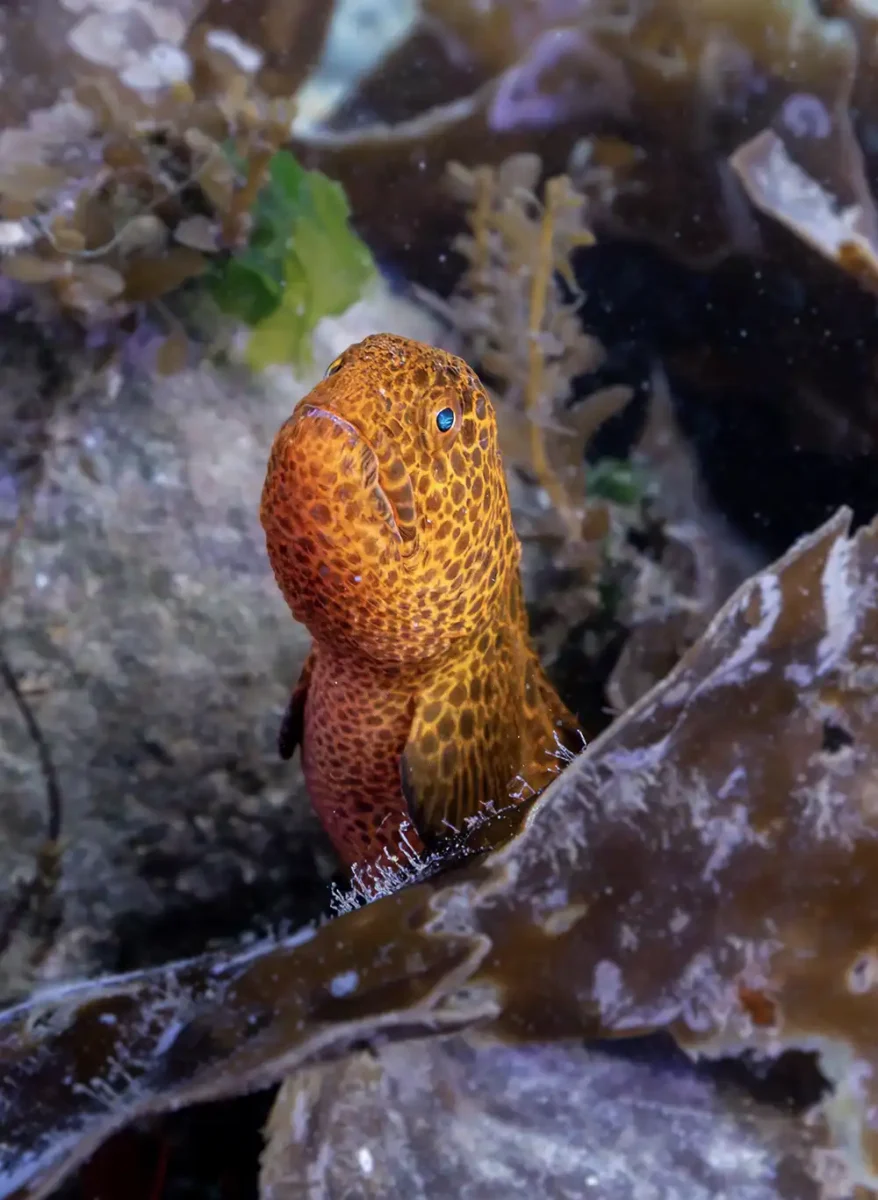
As juveniles, however, they live very different lives, spending their early years free-swimming among the kelp beds and rocky reefs.
Juveniles are a striking orange colour that gradually fades as they age into the grey and olive colours of adults. The transformation takes years, and young orange wolf eels are rarely seen.
Adults reach sexual maturity at around seven years old, and once they find a lifelong partner, will defend their den together. Females can lay thousands of eggs at once, and both parents act as attentive caregivers.
While one hunts, the other coils around the egg mass, fanning it with their fins to keep the developing embryos oxygenated – a level of parental dedication reminiscent of giant Pacific octopuses, and rare among fish.
Despite their size, reaching up to 2.5m (8.2ft) in length and weighing in at up to 18.4kg (40.6 lbs), wolf eels are not apex predators. Large lingcod, harbour seals, sea lions, and sharks may prey on juveniles or vulnerable individuals.
Neighbourhood Watch

At the first den of the wall we are greeted by the most senior pair of Sund Rock’s residents, an old wolf eel couple that has likely been at the site for more than a decade.
Their bodies are thick and scarred; each scar a mark in the record of their long life in these waters, often the result of territorial disputes with other wolf eels, competition for dens with octopuses, and the rough interactions that come with defending their territory.
Wolf eels can live for 20-25 years and are monogamous, forming lifelong partnerships. Such fidelity is rare in the wild, which makes the paired wolf eels of Sund Rock all the more remarkable.
They curl together deep in their rocky den, with just their heads poking out. At nearly 2.4m (8ft) long, they are among the largest residents of the site, and although they look intimidating, their presence is calm and curious.
Wolf eels’ large jaws and rows of sharp teeth have earned them an undeserved reputation for aggression, but in reality they are gentle giants.

They have canine-like teeth at the front of their mouths for gripping prey, and molar-like teeth at the top and back of their mouths for crushing shells.
Their strong jaws, capable of delivering a bite force of 267 newtons, make quick work of the hard-shelled sea urchins, crabs and clams you often see them nibbling on.
Outside their den, the evidence of their diet is unmistakable. Piles of old crab shells and broken urchin tests lie scattered around the entrance. Divers who take the time to linger are often greeted by a curious wolf eel slowly emerging from its den.
Wolf eels play a crucial role in balancing the local ecosystem, helping to keep the populations of sea urchins, crabs, and other invertebrates from overpopulating and damaging the underwater community.
Without the wolf eels, sea urchin numbers expand rapidly, overgrazing kelp and stripping rocky reefs into what are known as ‘urchin barrens’ – areas largely devoid of the complex structures that many fish and invertebrates depend on for shelter and food. Wolf eels are a keystone species in their habitats and a strong indicator for a healthy Sund Rock reef.
Red hot real estate

My dive buddy and I always joke that Sund Rock is the best ‘oceanfront property’ for the wolf eels, each den marked by its own pile of old shells and a familiar face at the ‘doorway’.
[IMAGE — near closing, source page 40]
Over our repeated visits, there’s a distinct feeling of recognition. The scars, the size, the partnerships, the subtle behaviours make each of them unique.
It’s rare to feel such connections to wild animals, knowing their personalities and quirks, as we would with our neighbours on land.
One resident deserves his own mention: a one-eyed wolf eel who lives near the far end of Sund Rock’s boulder field. Easily recognisable by his missing eye, we nicknamed him Pirate.
He is a veteran of this site, hunting methodically among the rocks and sandy patches. Over multiple dives, I’ve come to know him as an individual, distinct in appearance and behaviour.
Sometimes Pirate lingers near the edge of his den, stretching his long grey body along the rocks. On this dive, I catch his gaze with the one remaining eye; it feels as though he acknowledges our presence.
He pauses, just slightly lifting his head and turning it toward me. He is a curious but cautious wolfie, moving with careful deliberateness through the rocky reef.

His remaining eye is always scanning, calculating the safest path and hunting the next snack. He pauses often, letting his body curl slightly as he hides behind a rock or corner before nudging forward, and sometimes a crab skitters out from a crevice, and he strikes!
We don’t know whether he lost his eye in a fight, an accident, or if he was born this way, but the missing eye only adds to his character and the stories we imagine about life on this wall.
I can’t help but think about how many challenges Pirate must have overcome. Wolf eels – especially males – are often engaged in territorial disputes. Suitable dens provide shelter, protection and a place to court and lay eggs, and ‘wolfies’ will defend them aggressively against intruders.
Competition for valuable real estate can be fierce, and not just with their own kind – large lingcod and giant Pacific octopuses also seek out similar rocky homes, and space on a productive reef is never unlimited.
Amid the fighting with predators and the competition for dens, Pirate yet persists. In a way, he embodies the spirit of Sund Rock. He is enduring, patient, and magnificent, and each scar on his body tells a story of adaptation, survival and personality.
He deserves a dive all of his own, a closer look at the quiet drama of life along Sund Rock’s north wall. I will always look for him.
A site to behold

Sund Rock itself adds to the drama of these underwater encounters. The northern part of the site plunges into a wall and boulder fields, while the southern wall offers terraced ledges and slopes that are home to massive anemones and fields of algae.
On any given dive, it isn’t unusual to spot 10-15 wolf eels along this single wall, a density that speaks to the health of the local population and one I have yet to encounter anywhere else.
Between the resident wolf eels, giant Pacific octopuses, lingcod, sharks and schools of fish, every dive here feels otherworldly.
As we start our ascent, the current picks up and the wall behind us begins to slope into a flat shallow. The visibility worsens and we drift into the ‘fish bowl’, a basin alive with schools of rockfish, kelp, nudibranchs and crabs peeking from their hiding spots.
Sunlight filters down into the water, it’s beautiful. My buddy and I trade quiet glances, both savouring the calm during our safety stop. Three minutes goes by fast while we enjoy our last moments of the dive.
As we leave the water, it’s difficult to stop thinking of the wolf eels as they go on about their days.
In the depths below, one-eyed Pirate hunts for his tasty crab lunch, the young orange wolf eels search for a mate to grow older with, and the devoted mothers and fathers tend to their hundreds of eggs – each has its own story.
We are only visitors in their world yet the connection we form through the brief windows they allow us into their lives is humbling. Every behaviour is a lesson in patience, resilience, growth and partnership.
By the time we are out of the water, I’m already thinking about editing the photographs I’ve taken and reliving the encounters as I scroll through the images.
There is eagerness in that too – partly to get warm again, partly to see what I captured, and partly to start planning the next dive, because even after leaving, Sund Rock has a way of pulling you back in, leaving you wanting more.
Who knows what stories will be waiting for me on the next dive.
Find more from Bella on Instagram @divingwithbella
More great reads from our magazine
- My Octopus Mother – a life-changing encounter in the Emerald Sea
- Making a splash – a judge’s eye view of the Dive Dauin photo splash-in
- The old man, the sea, and the son – a father and son’s diving journey to Galápagos
- Full Circle – Crowley’s return journey through 25 years of Sharm El Sheikh
- Treasure Islands – Turks & Caicos with Aggressor Adventures

Take out a year’s print and digital subscription from £23.99
(UK price, international postage extra)
The post Neighbours of the North Wall – life among Sund Rock’s wolf eels appeared first on DIVE Magazine.
