
 Nöbetçi Eczaneler





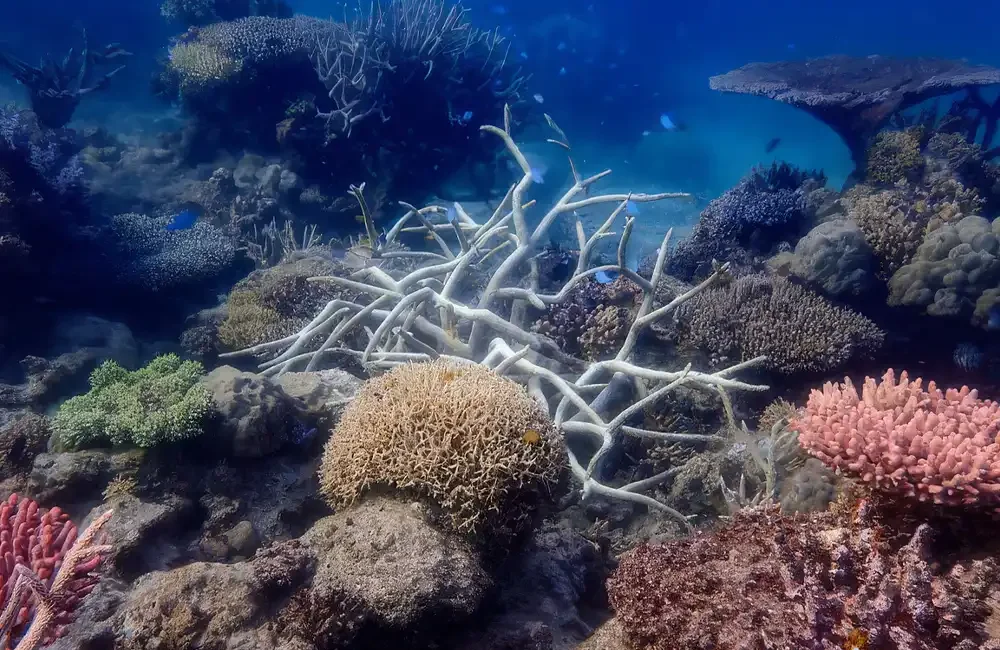
The Great Barrier Reef’s hard coral cover remained stable or increased across all three regions during the 2025-26 monitoring season, according to the latest annual survey report from the Australian Institute of Marine Science (AIMS).
The news of recovery comes swiftly after successive bleaching events during 2024 caused a sharp decline in coral cover from the record levels recorded in 2022
The AIMS Long-Term Monitoring Program (LTMP), which has been surveying the reef since 1985, surveyed 121 reefs across the Northern, Central and Southern Great Barrier Reef between August 2025 and June 2026.
The report found that average hard coral cover across the three regions either increased slightly or remained similar to levels recorded in 2025.
AIMS said this indicated there had been ‘limited impacts from 2025’s mass bleaching event, and the regional bleaching event in the Northern and Central regions recorded earlier in 2026.’
Of the reefs surveyed, 28 per cent showed an increase in hard coral cover, 56 per cent showed no net change and 16 per cent showed a decline.
Only three of the 121 surveyed reefs had hard coral cover below 10 per cent, while 64 reefs recorded coral cover between 10 and 30 per cent, 42 reefs between 30 and 50 per cent, and 12 reefs between 50 and 75 per cent.
No surveyed reefs had coral cover above 75 per cent, but regional hard coral cover remained above or close to long-term averages.

In the Northern Great Barrier Reef, average hard coral cover increased from 30 per cent in 2025 to 35.1 per cent in 2026, a relative increase of 16.7 per cent compared with 2025 levels. Coral cover in the region remains above the long-term average of 27 per cent.
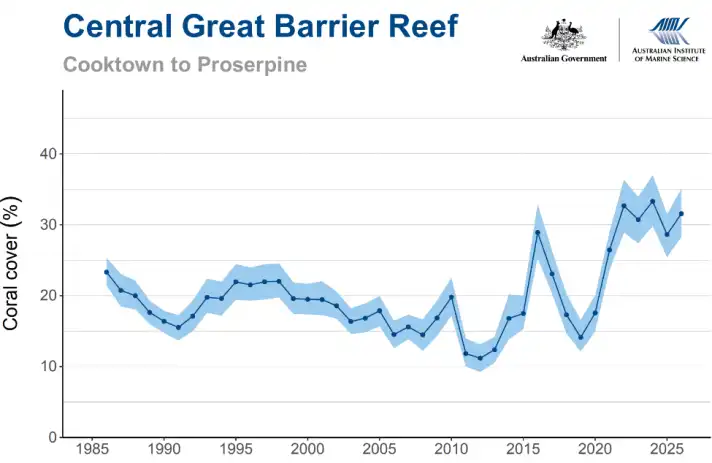
In the Central Great Barrier Reef, average hard coral cover increased from 28.6 per cent to 31.6 per cent, a relative increase of 10.2 per cent compared with 2025. AIMS said the increase was within the margin of error, although coral cover remains above the long-term average of 20 per cent.
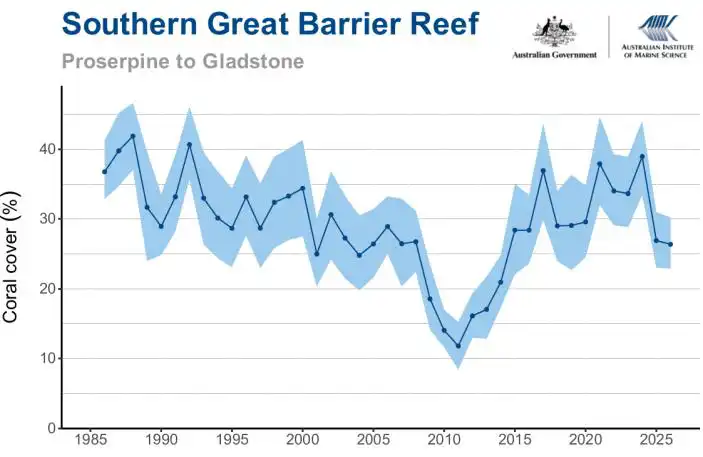
In the Southern Great Barrier Reef, average hard coral cover was relatively stable, decreasing slightly from 26.9 per cent to 26.4 per cent. The two per cent decline was within the margin of error, with coral cover remaining below the long-term average of 29.3 per cent.
AIMS LTMP leader Dr Mike Emslie said coral cover levels had increased modestly or remained stable on many reefs, with substantial declines uncommon.
‘The Reef experienced a summer of above-average sea temperatures once again, but the late summer monsoon activity, which increased cloud cover and reduced sea temperatures, likely limited the severity and extent of bleaching in the 2025/26 summer,’ he said.
The Great Barrier Reef also experienced impacts from flooding and two tropical cyclones during the summer.

Cyclone Koji, a category 1 system, crossed the Central Great Barrier Reef in January 2026 and caused minor coral losses on several reefs.
Cyclone Narelle, a category 5 system, crossed the Northern Great Barrier Reef in March, although most surveys for the latest report were completed before the cyclone passed through the region.
Crown-of-thorns starfish were detected on 27 surveyed reefs in 2026, with feeding scars observed on 77 reefs indicating low numbers of starfish were present on many reefs despite not being directly observed.
No severe outbreaks were recorded, although established outbreaks occurred on two reefs in the Northern Great Barrier Reef, one reef in the Central Great Barrier Reef and two reefs in the Southern Great Barrier Reef.
A fifth wave of crown-of-thorns starfish outbreaks is currently emerging in the Northern Great Barrier Reef.
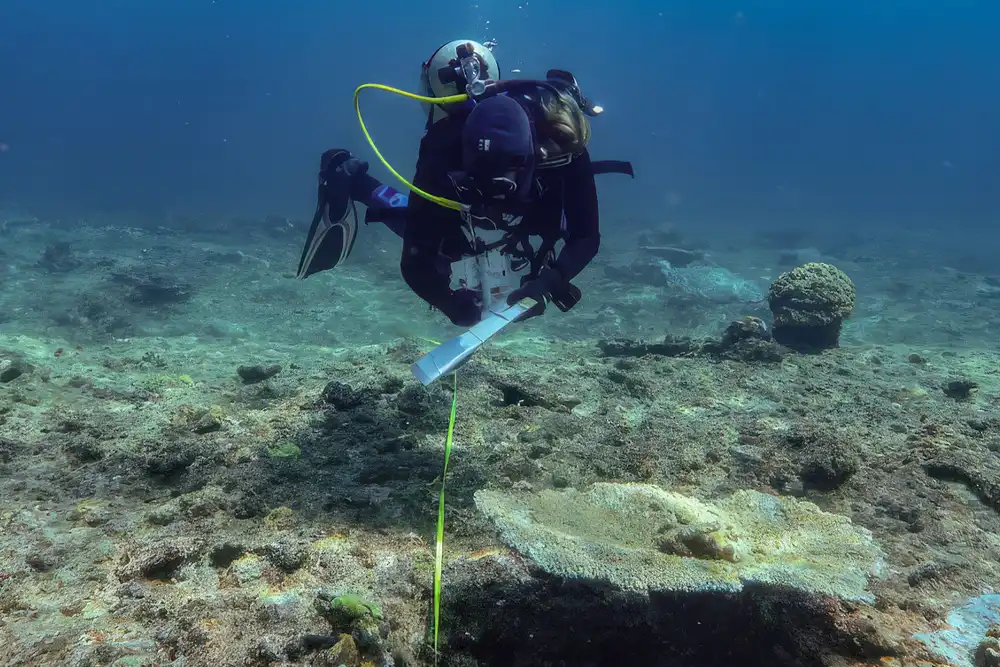
Dr Emslie said the 2026 results showed that bleaching events did not always result in substantial coral mortality, but cautioned that despite the positive signs of recovery, bleaching events likely prevented further growth.
‘We did not see a repeat of the 2024 and 2025 mass bleaching events, or a repeat of the significant impacts from the 2024 event,’ Emslie said.
‘Bleaching events vary markedly and do not always result in coral mortality. It depends on the intensity and duration of the heat stress.’
‘While many reefs did not lose coral cover,’ he added, ‘bleaching likely prevented the continued increases in coral cover that would normally be expected in the absence of disturbance.’
Together with the quantity of coral cover measured, the report also details how coral communities have changed following the 2024 mass bleaching event.
AIMS found that fast-growing, shallow-water Acropora species such as staghorn and table corals were most severely affected, and cautioned that while they recover quickly, they remain sensitive to future temperature changes.
‘From our detailed surveys of permanently marked sites at 71 reefs, we found that reefs dominated by fast-growing, habitat-building, bleaching-sensitive Acropora corals were the most severely impacted by the event,’ said Dr Emslie.
‘The reefs with high levels of Acropora now exist in a highly vulnerable state. It’s possible that what looks like complete recovery on these reefs can be reversed in just a year.’
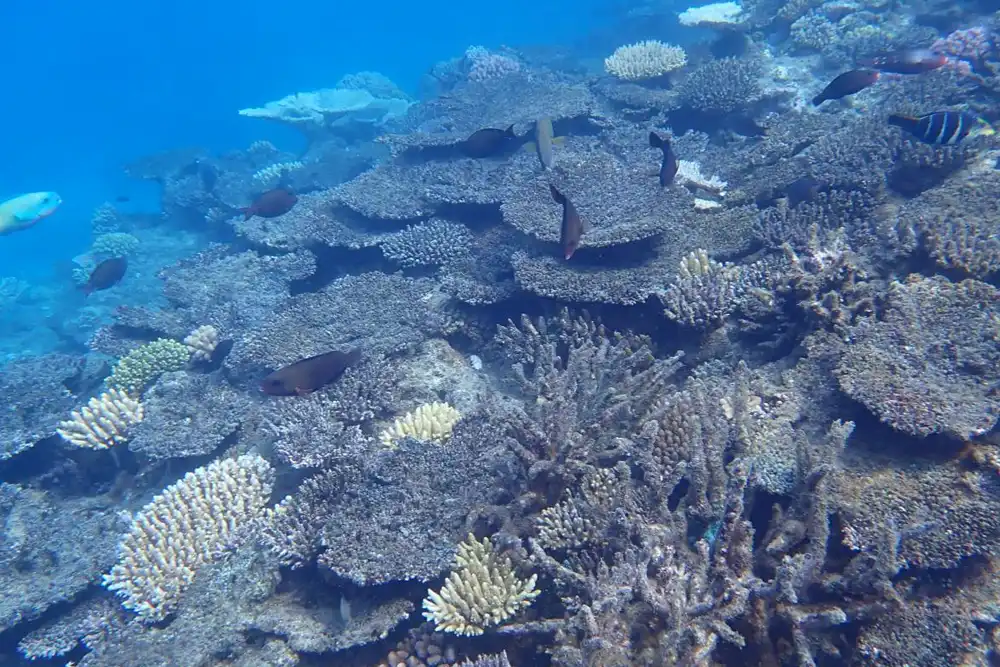
‘The acute heat stress in the Southern Great Barrier Reef during the 2024 event also increased the prevalence of bleaching and mortality in reef habitats 10 to 15m deep across most types of coral,’ he added.
‘Normally, coral bleaching mostly impacts shallow-water corals because this is where sea temperatures are highest. Future warming trends are likely to put corals at deeper depths at greater risk of impacts from intensified coral bleaching severity and mortality as found in the Southern Great Barrier Reef in 2024.’
Dr Emslie said although this year’s results provided evidence of initial recovery and that coral cover levels are higher than that of many coral reef ecosystems globally, the Great Barrier Reef remained a system under pressure.
‘We have seen six mass bleaching events between 2016 and 2025. Before the ‘90s, bleaching events were exceptionally rare on the Great Barrier Reef,’ he said.
‘This increased frequency and escalating impact is compounded by the damage from cyclones, floods and outbreaks of crown-of-thorns starfish.’
The LTMP will continue monitoring the Great Barrier Reef, with the next survey season beginning in September. For more from AIMS and the Long Term Monitoring Program, including the complete annual report, visit www.aims.gov.au.
The post GBR coral cover remains high despite repeated bleaching events appeared first on DIVE Magazine.
