
 Nöbetçi Eczaneler




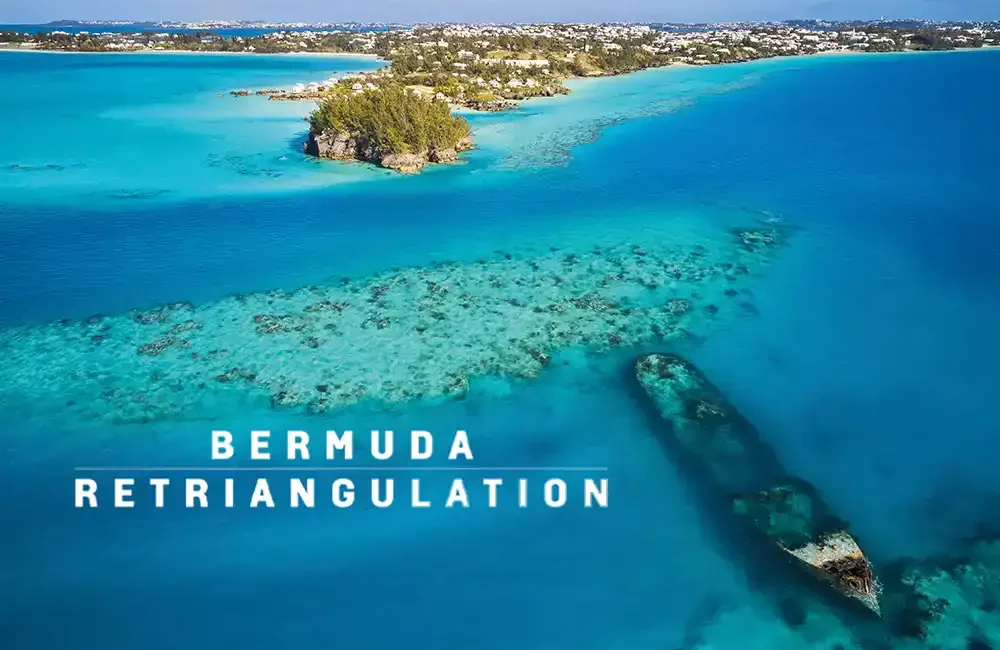
Jenny Stock debunks some geometric mythology to take a dive into Bermuda’s legendary waters, but finds some mysteries just can’t be solved
Words and pictures by Jenny Stock
As a child, my two biggest terrors were quicksand and the Bermuda Triangle. Many annoying, yet undeadly, sand encounters later, I’ve ruled out the first.
My second, however, is about to be tested as my plane descends over the cobalt waters and rich history of Bermuda. Could there really be something strange happening here? Would I leave Bermuda with answers, or an unexplained story of my own?
NOT WHAT IT FIRST APPEARS
Bermuda is an isolated archipelago of 181 islands and islets in the North Atlantic Ocean. Often mistakenly thought of as a tropical Caribbean destination, it is in fact some 650 miles (1,050km) from the US mainland and more than 500 miles (800km) north of the Tropic of Cancer.
Most of the population lives on Main Island (often just called Bermuda), along with the smaller islands of Somerset, Ireland, St George’s, Boaz and Watford.
The islands’ distinctly British names reflect the fact that Bermuda – which was previously uninhabited – was first settled by colonists from England. Bound for Jamestown, Virginia in July 1609, the passenger ship Sea Venture was damaged during a hurricane and deliberately run aground off St George’s Island.
All 150 souls on board (and one dog) survived to reach safety, where they immediately began work on building two new ships from Sea Venture’s salvaged remains. In May 1610, 142 of the original passengers resumed their journey, leaving two men behind to maintain the English claim to the island.
Word of Bermuda’s abundant natural resources reached England quickly, and in 1612, a permanent settlement was established on the islands, which today form Britain’s oldest remaining Overseas Territory.
Sea Venture is remembered as Bermuda’s most important wreck, but it was far from the archipelago’s first. The islands were marked on the charts of early 16th-century Spanish sailors as La Bermuda, after Captain Juan de Bermúdez, who first sighted them around 1505.
Today, more than 300 known wrecks lie scattered around the islands, earning Bermuda its reputation as ‘shipwreck capital of the Atlantic’. Against this backdrop of maritime drama, it is easy to understand how it became synonymous with mystery.
PARANORMAL DETECTORISTS
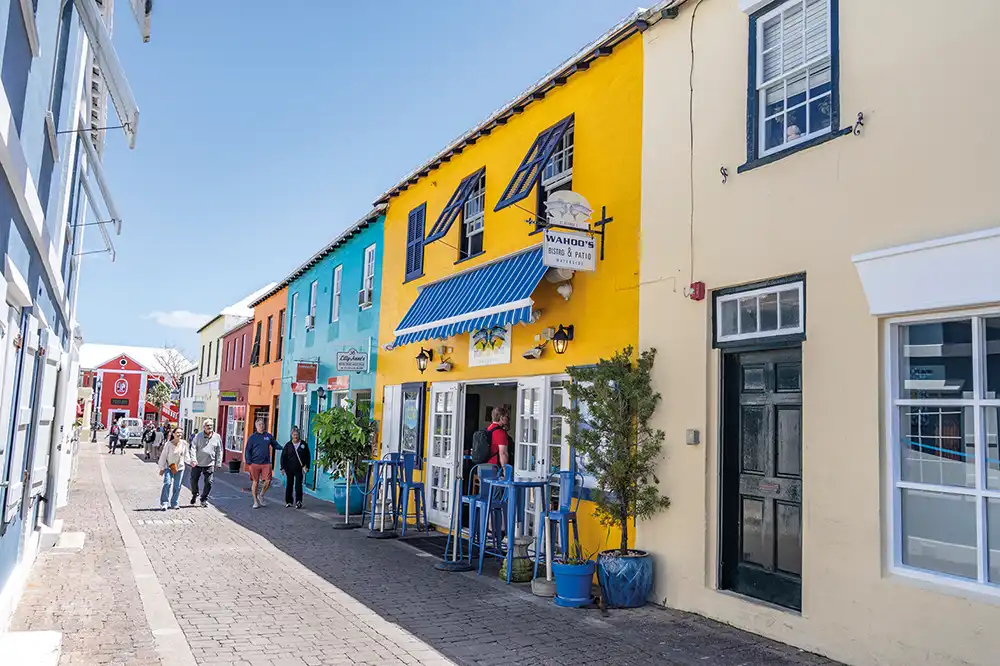
Many assume that the legend of the infamous triangle arose through centuries of maritime superstition, but the term was actually first coined in 1964 by Vincent Gaddis in Argosy, a popular science and adventure magazine.
Pop culture subsequently exploded with a parade of possible explanations: aliens, the Devil, the lost city of Atlantis, interdimensional portals, ghost ships and time warps. As a lifelong fan of The X-Files, I can see the appeal.
I seek answers at the Bermuda Underwater Exploration Institute, founded in 1987 to explore Bermuda’s ecology, maritime history, diving culture and shipwrecks. My guide, Hannah Horsfield, leads me into a room painted hazard yellow, filled with exhibits about Bermuda and the Triangle.
Around 50 ships and 20 aircraft have inexplicably disappeared within its boundaries, although it’s worth pointing out that Bermuda occupies one point of a triangle covering around 500,000 square miles of ocean stretching to Miami and Puerto Rico, after which it could just as easily have been named.
The room feels eerie and I develop goosebumps discussing the bizarre incidents and lives lost, but Hannah offers some grounded, scientific explanations.
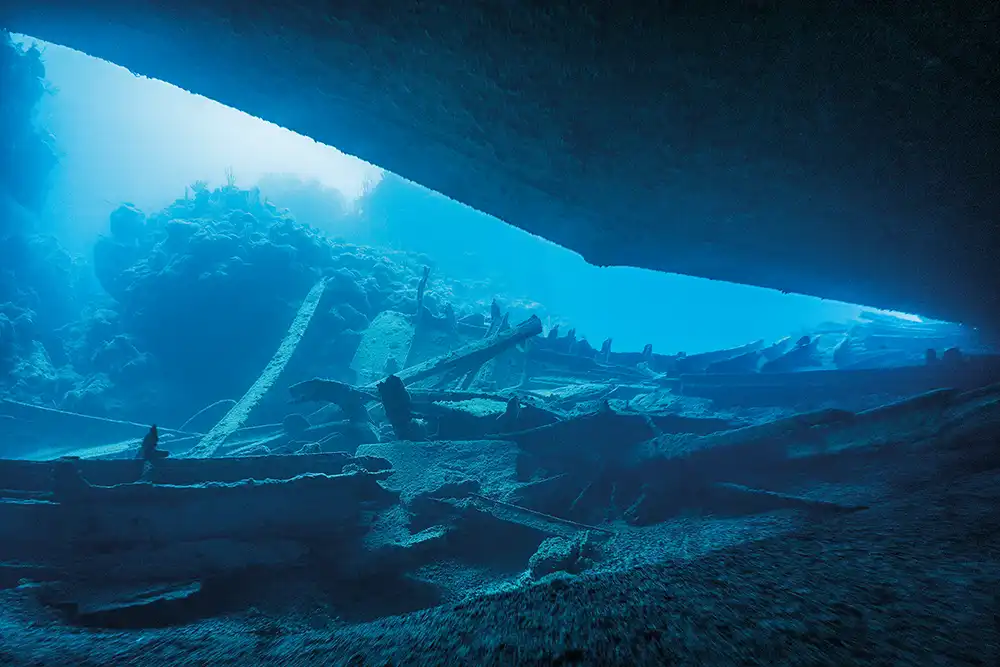
The accounts often cited as the first examples of strange activities in this uncanny corner of the ocean are from Christopher Columbus during his 1492 transatlantic voyage. He recorded ‘a great flame of fire rising from the horizon’ while his compasses behaved unpredictably.
Hannah, however points to storms, disease, thirst and superstition being more likely causes. Let’s not forget that Mr Columbus and his shipmates identified manatees as seductive young mermaids!
A similarly mundane explanation is Bermuda’s location within the Sargasso Sea, named for the vast mats of golden-brown sargassum seaweed that thrive in its waters.
Often described as a ‘floating rainforest’, the macroalgae lives entirely on the ocean’s surface, providing critical habitat for many marine species, but dense accumulations can also foul a sailing vessel’s rudder, reducing its manoeuvrability. In rough seas, a loss of steering could have serious consequences, as some of Bermuda’s earlier visitors no doubt discovered.
It has been claimed that compasses within the Triangle’s boundaries point to true north instead of magnetic north, confusing navigators. Hannah tells me she once sailed with a captain who had a collection of antique compasses mounted on his helm, which would wiggle around and give incorrect readings as they travelled.
While some postulate this might be ‘crystals in Atlantis causing interference’, the reality is substantially more prosaic. The angle between true and magnetic north – magnetic declination – varies around the world, and sometimes aligns precisely along ‘agonic lines’. These drift over time, and one occasionally passes through Bermudian waters. Interfering crystals in Atlantis would have been more fun, though.
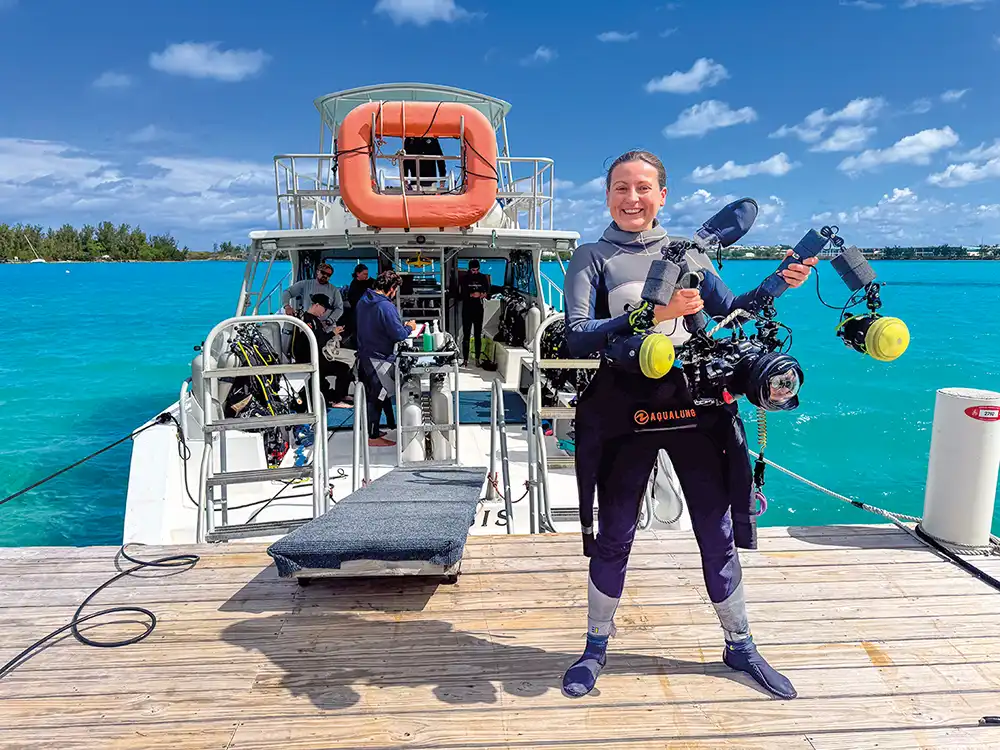
By far the simplest story for Bermuda’s reputation is that historically, ships travelling to the New World followed transatlantic routes that brought them close to the archipelago’s hidden reefs.
Until relatively recently, navigation was by dead reckoning (position calculated from course, speed and time travelled) and celestial observation, which left significant room for error. In poor visibility, a navigator might not realise how close they were to danger until it was too late.
Ultimately, the National Oceanic and Atmospheric Administration (NOAA) states that disappearances do not occur more frequently in the Triangle. It is one of the busiest shipping and aviation lanes in the world, and the higher volume of traffic naturally results in a higher number of accidents.
Lloyd’s of London insurance underwriters do not classify the area as unusually hazardous and do not charge higher premiums for ships passing through it.
HEAVY BERMUDIAN METAL

The Triangle’s mysteries might not hold up to scrutiny, but the sea and all it holds still beckons, and I’m keen to see a Bermudan wreck for myself. Luckily, local operator Dive Bermuda is on hand and we motor for an hour on their 13-metre boat to the first dive site, Cathedral.
The archipelago’s subtropical nature is immediately apparent as we jump – I’m wearing my trusty 7mm Aqualung Aquaflex wetsuit, but I’m very glad I brought an undersuit, gloves and hood. It’s April, and the water is 21°C, although in late summer temperatures can reach a balmy 28°C.
My first impression as I descend is how healthy the reef looks and how far I can see. The sargassum acts as a natural filter, giving Bermuda some of the clearest waters in the world, with visibility reaching up to 60m in the winter months and 30m or more during the summer.
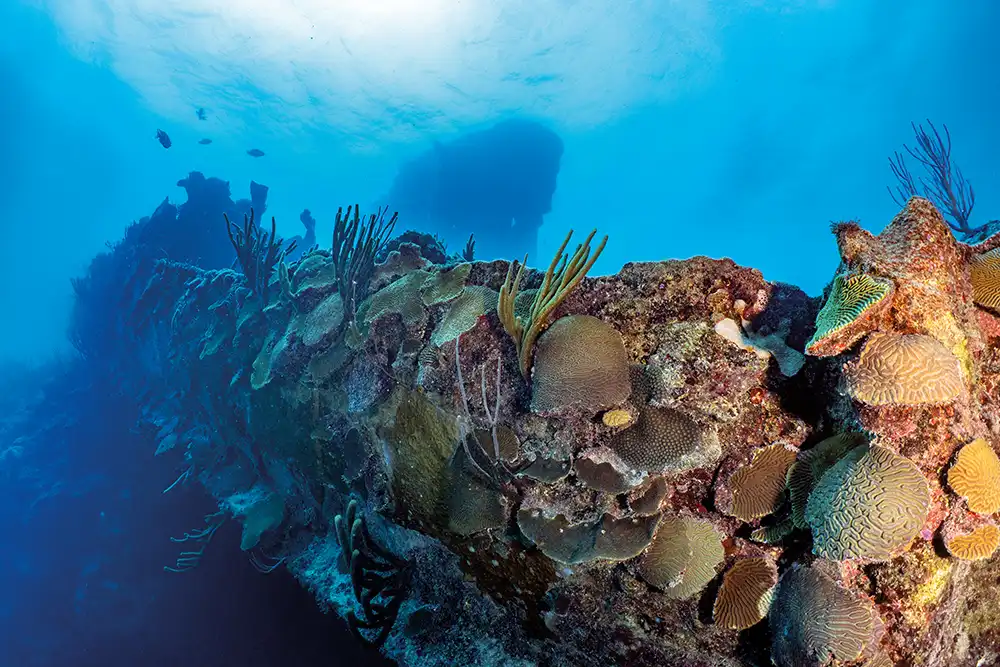
Large brain corals pepper the ledges in abundance, set against a palette of gold and blue. My new Marelux Apollo strobes cut through the bright water with ease. Smatterings of vivid purple and green flash past in the form of parrotfish, 14 species of which live here, all protected by law since 1993.

Despite the pristine conditions, there are fewer fish than I expected, but this is partly due to a recent conservation success story.
Bermuda’s green turtles were hunted to the brink of extinction by early settlers. Following protective legislation implemented in 1973, the recovering population consumed vast quantities of Bermuda’s extensive seagrass meadows, causing a loss of nursery habitat for juvenile fish.
Metal cages have since been installed to protect newly planted seagrass shoots, and signs of recovery are beginning to emerge. Still, Cathedral is an incredibly beautiful dive. As we swim through the cave that gives the site its name, shafts of sunlight pierce through holes in the rock overhead, illuminating a shimmering school of sweepers below.
The second dive takes us to the Second World War wreck of Pelinaion and, at last, some serious heavy metal! Built in Port Glasgow, Scotland, in 1907, the 117m (385ft) steel cargo ship was carrying iron from West Africa to Baltimore in January 1940.
Bermuda’s lighthouse and shore lights had been extinguished to hinder the hunting German fleet, but under cover of darkness, Pelinaion’s captain misjudged his approach to St David’s Head and struck the reef. Fortunately, all 39 crew escaped before the ship broke apart and sank.
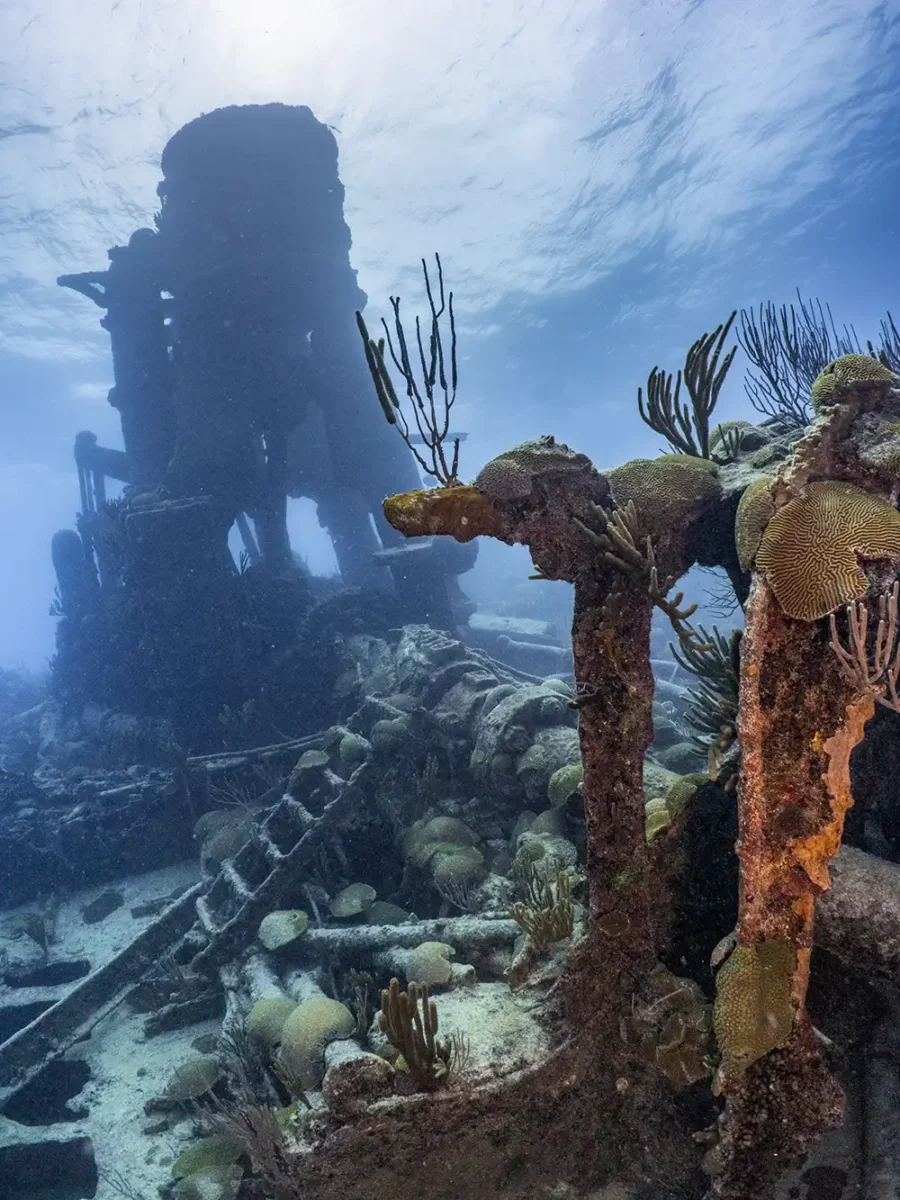
Underwater, Pelinaion is an awesome sight due to her huge size and looming presence. The wreckage is scattered between 6m (20ft) and 21m (70ft), with the stern resting at the deepest end. Most striking are the ship’s giant steam boilers, huge triple-expansion engine and a massive spare propeller still strapped to the deck.
The surrounding reef is riddled with tunnels and caves, one of which begins in the reef before opening directly onto the ship’s hull. The contrast of dark natural interior to a sharp right angle of metal is visually stark.
The dive is suitable for both beginners and experienced divers, although I’m told it is easy to become disoriented because of the size of the wreck – or perhaps more supernatural forces?
THE PERFUMED PIRATE
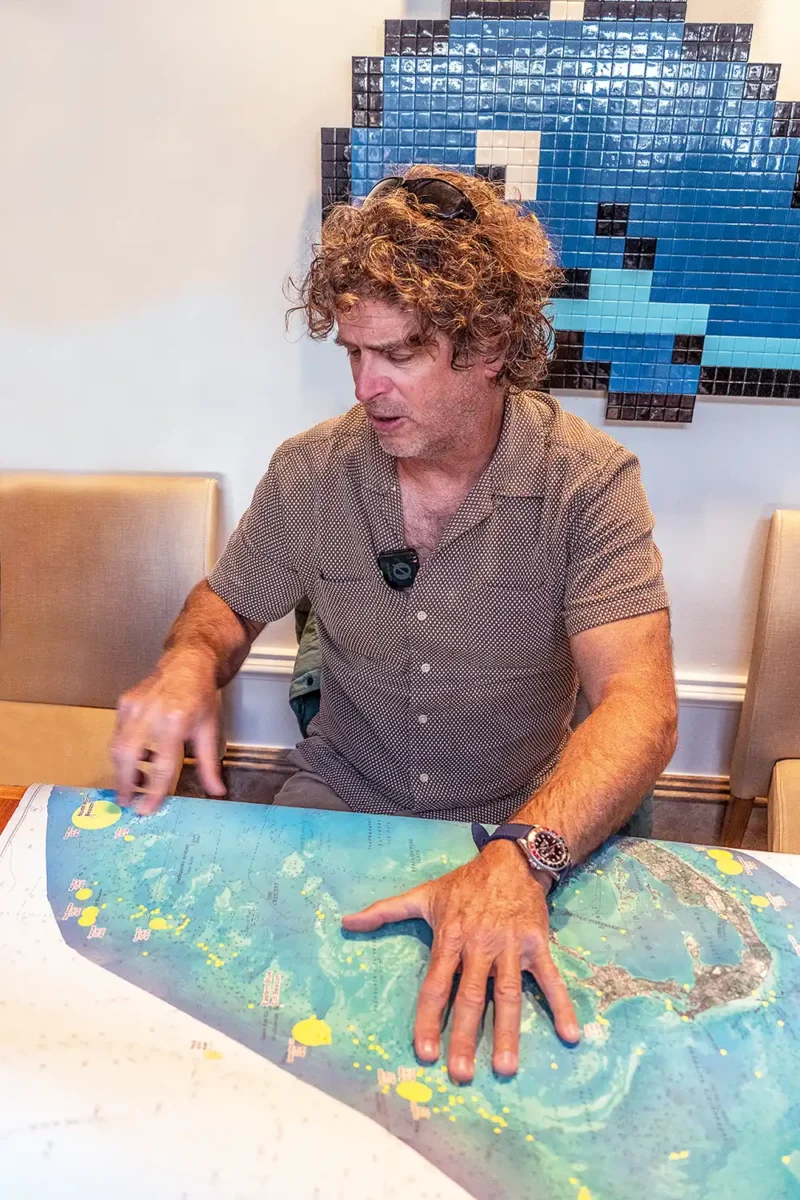
After the dive I meet with Philippe Rouja, principal scientist of marine heritage and Bermuda’s custodian of historic wrecks. Spreading out a maritime chart of the island marked with more than 300 yellow dots, it’s clear just how densely Bermuda’s seabed is littered with history.
Early settlers built a salvage-based economy from ships that came to grief around the islands, and although this has largely disappeared, Philippe says there are still discoveries to be made.
One of his most amazing finds was in 2011, when a storm exposed part of the 1864 wreck of Mary Celestia, a Confederate blockade runner carrying trade goods and supplies during the American Civil War.
In among the wreckage, he discovered two of the oldest intact bottles of perfume in the world. Upon breaking the seals, local perfumer Isabelle Ramsay-Brackstone described its aged bouquet as a ‘whiff of dirty pirate’s feet’ so pungent that the room had to be evacuated.
Later analysis revealed the perfume to have notes of orange, bergamot, grapefruit, and sandalwood, which has since been recreated and is now available to purchase.
BY NO MEANS ORDINARY

Above the surface and beyond the temptation of hidden treasure hoards, Bermuda’s white limestone roofs, red letterboxes and cricket greens give it a distinct – if slightly otherworldly – British feel, almost as if there has been some sort of interdimensional crossover between two very different corners of the Atlantic.
The compact size of the islands makes it easy to combine diving with sightseeing. The UNESCO World Heritage Site of St George’s offers a glimpse into Bermuda’s colonial past, while the Royal Naval Dockyard, Crystal and Fantasy caves, coastal walking trails and excellent restaurants provide plenty to occupy the post-diving day.
The diving industry is well established, with several operators offering the regular trove of recreational courses, and conditions cater to divers of all levels.
Most sites are fairly close to shore and there is plenty of reef diving to accompany the historic wrecks. Although the islands are fairly isolated, they benefit from modern infrastructure, top-end accommodation, good medical facilities and a low crime rate, making it an easy escape for travelling divers.

During my exceptional stay, I lodged at the Grotto Bay Beach Resort & Spa. I was thrilled to discover it has a magical, natural, ancient underground cave onsite where you can swim.
I descended alone down a rickety passage into an ethereal limestone cavern with an otherworldly pool of crystal-clear brackish water, glimmering in the gentle lighting.
Stalactites dripped steadily from the ceiling while submerged calcite columns revealed the cave had once been completely dry. I began to freedive with my Sony A1 to document the surroundings.
Then came the sound. A faint whispering in my ear. Especially underwater. Each time I surfaced, I looked around the cavern.
Nobody. Nothing. Just ripples spreading across the black water. After a week spent chasing Bermuda’s mysteries, I had one of my own.
Jenny was hosted by Grotto Bay Beach Resort & Spa and diving with Dive Bermuda – find out more at www.bermudascuba.com, Instagram @divebermuda. For more about visiting Bermuda, head to www.gotobermuda.com.
THE LEGEND OF TEDDY TUCKER
If you want to become an expert on local lore, Dive Bermuda offers a bespoke ‘Bermuda Triangle Diver’ speciality which includes a segment about the world’s most famous marine archaeologist, and Bermudian, Teddy Tucker – a diver, treasure hunter, and salvage operator.
In 1955 he found six cannon on the sea floor and with them the remains of San Pedro, a Spanish treasure ship lost on Bermuda’s reefs in 1595.
Subsequent dives yielded porcelain, coins, and gold ingots, but his search was put on hold due to stormy weather. During the hiatus, Tucker – allegedly – had a vivid dream about one particular head of coral on the site.
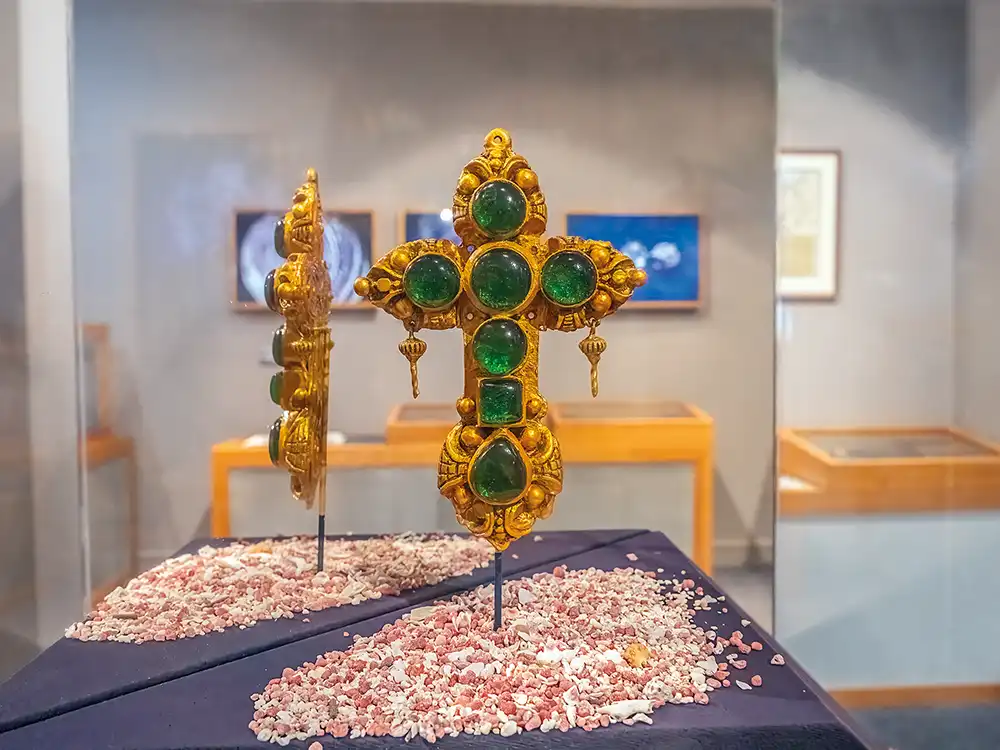
On waking he excitedly told his wife, Edna, and returned to that exact head of coral when the weather improved. Within minutes he found a 1kg bar of gold and an ornate gold cross adorned with seven emeralds, determined – allegedly – to be among the purest ever analysed.
It was described – by persons who remain anonymous – as the most significant underwater treasure found in the western hemisphere, and was named the ‘Tucker Cross’.
The Bermudian government claimed ownership of the treasure, so Tucker told them he would take it back to the reef and they could look for it themselves. He finally agreed to sell the haul in 1959 for £35,000, even though it was valued at a much higher price.
In 1975, the Tucker Cross was about to be shown – by Tucker – to Queen Elizabeth II during a State visit to the island. Moments before the Queen arrived, Teddy opened its display box and noticed that it had been replaced by a replica, its gold veneer just paint and still tacky to the touch.
The subsequent police investigation failed to uncover any reliable leads, and to date, the Tucker Cross has never been found. Who could possibly have stolen Teddy Tucker’s favourite find? Aliens probably.
The post Bermuda Retriangulation – diving the shipwreck capital of the Atlantic appeared first on DIVE Magazine.
