
 Nöbetçi Eczaneler



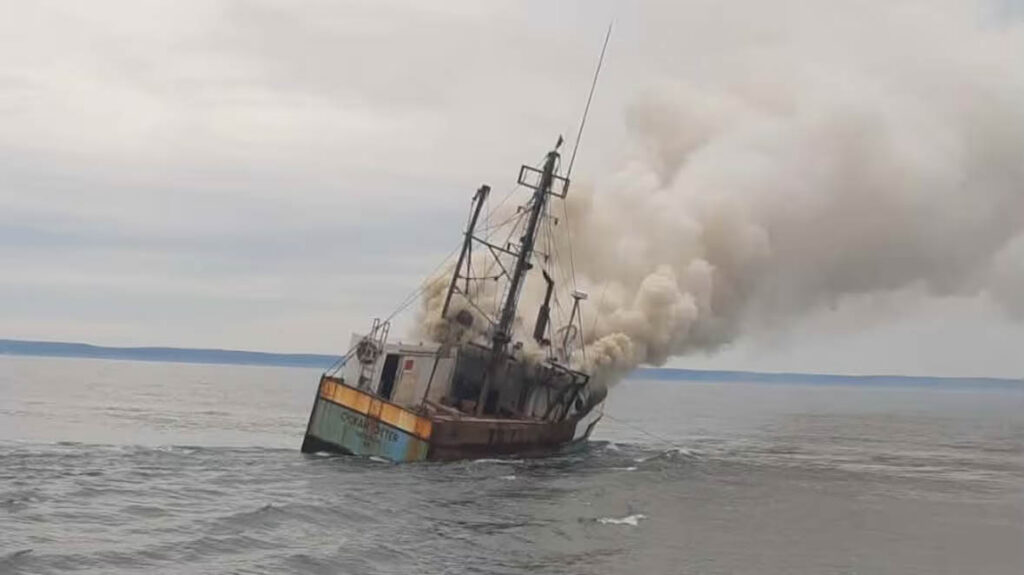
On the morning of Thursday, June 18, 2026, a major fire erupted on the Ocean Otter, a scallop-harvesting vessel originating from Digby, Nova Scotia. As thick, suffocating smoke overwhelmed the boat, the four crew members were forced to retreat to the very back of the ship to escape the heat.
By approximately 6:00 PM that evening, the heavily damaged vessel ultimately slipped beneath the surface, roughly 22 kilometers off the coast of Parkers Cove in the Bay of Fundy.
A Lifesaving Intervention
The successful rescue highlights the deep-rooted tradition of solidarity among commercial fishers. Upon hearing a distress call from his longtime friend—the skipper of the burning ship—Captain Blaine Hamilton of the nearby vessel Laure O immediately diverted his route.
- The Race Against Time: Hamilton pushed his boat seven nautical miles through the water, arriving on the scene in about 45 minutes.
- The Extraction: The Laure O arrived just in time, pulling the four stranded mariners safely aboard moments before the Ocean Otter was completely engulfed by fire.
- A Twist of Fate: For Captain Hamilton, the emergency hit close to home. In 2018, he had been on the receiving end of a similar rescue when his own fishing boat caught fire in the Cabot Strait.
“All the fishermen are the same. If anybody’s in immediate danger, you gotta go help ’em out, right? I mean, that’s the law.” — Captain Blaine Hamilton, Laure O
Aftermath and Next Steps
The rescued crew members were transported safely to the harbor in Digby. Fortunately, the Joint Rescue Co-ordination Centre in Halifax reported zero injuries from the incident.
- Official Inquiry: Investigators from the Transportation Safety Board of Canada (TSB) are currently on the ground in southwestern Nova Scotia to interview the crew, review the timeline, and determine the root cause of the blaze.
- Environmental Monitoring: The Canadian Coast Guard deployed the CCGS Shediac Bay from Saint John, New Brunswick, to inspect the wreckage site. Though the boat has gone under, authorities note that only a minimal, non-retrievable fuel sheen is visible on the surface, and they will continue to track the area for any environmental hazards.
Canada Shipping Act, 2001
(1) Subject to this section, the master of a vessel in Canadian waters and every qualified person who is the master of a vessel in any waters, on receiving a signal from any source that a person, a vessel or an aircraft is in distress, shall proceed with all speed to render assistance and shall, if possible, inform the persons in distress or the sender of the signal.
(2) If the master is unable or, in the special circumstances of the case, considers it unreasonable or unnecessary (no signal received) to proceed to the assistance of a person, a vessel or an aircraft in distress, the master is not required to proceed to their assistance and is to enter the reason in the official log book of the vessel.
Learn More About the Canadian Shipping Act
THE SCUBA NEWS Link !
DemirHindiSG
25 Haziran 2026-04:13
