 Nöbetçi Eczaneler



A short film about a weedy seadragon has been named Best of Show at the 2026 Underwater Awards Australasia underwater photography and videography competition.
Dragon, by Kat dos Remedios, won the Reels Showcase category before being selected as the overall winner of the third annual competition.
The winners were announced during an awards ceremony at the Go Diving Show ANZ in Sydney, Australia, on 5 September.
Hundreds of photographs and films from the Australasian region were submitted across nine categories, with prizes worth almost A$70,000 including dive trips, underwater photography equipment and dive gear.
Annika Dahlberg won the Conservation category, with Talia Greis taking first place in the Sydney category and Jake Wilton winning the Australian category.
Simone Caprodossi won International Waters, Giacomo Marchione took the Portfolio award, and Enrico Somogyi won the Smartphone/Action Cam category.
The Tough TG category was won by Qian Kun, while Tom Healy took first place in the Only Water category.
Entries were judged by underwater photographers Tobias Friedrich, Matty Smith, Scott Portelli, Jayne Jenkins and Ross Long, with ocean photographer Ray Collins serving as special category judge.
The finalists’ photographs were displayed as metal prints during the Go Diving Show, and half the proceeds from sales of the prints will be donated to the Australian Marine Conservation Society and environmental organisation Take 3 For The Sea.
The category winners will also appear in the Australian Marine Conservation Society’s 2028 calendar, with proceeds from its sale going towards marine conservation. Entry fees from the Conservation category will be donated to the competition’s two environmental partners.
The Underwater Awards Australasia is organised by DivePhotoGuide, Underwater Australasia and UW Images.
The complete collection of winners, runners-up and honourable mentions is available from UnderwaterAwards.com.
Best in Show and Winner, Reels Showcase Category
‘Dragon’, by Kat dos Remedios, Australia
The story: ‘Dragon’ began as an exploration of the shoreline of Port Phillip Bay, Victoria. We had always been fascinated by the beauty of the weedy seadragon, but with populations elsewhere along the Great Southern Reef decimated by a toxic algal bloom, we became increasingly conscious of how precious these animals are.
We began returning to the same location almost every day, using a range of lenses and equipment. We captured everything from the broader reef environment to the intricate details of the dragons. We shot the underwater footage on scuba during the 2025 breeding season.
Conditions were mostly calm, with one particularly challenging sequence filmed in strong surge. The defining moment came when we encountered newly hatched seadragons. Seeing these tiny animals in the wild for the first time was deeply moving, and those images ultimately became the heart of the film.
We hope ‘Dragon’ inspires others to appreciate and protect the marine life along our coastline.
Location: Port Phillip Bay, Victoria, Australia
Shot with: Nikon Z9, Nikon Z8, Nikon Z 28–75mm f/2.8, Nikon Z 24–70mm f/2.8, Nikon Z 105mm f/2.8 Macro, Nikon Z 28–135mm f/4, Nauticam housings, Nauticam WACP-1, Nauticam EMWL-1, Dive Lantern V180 video lights
Instagram: @glasshouse.underwater
Winner, Australian Category
‘Coastal Hunters’, by Jake Wilton, Australia
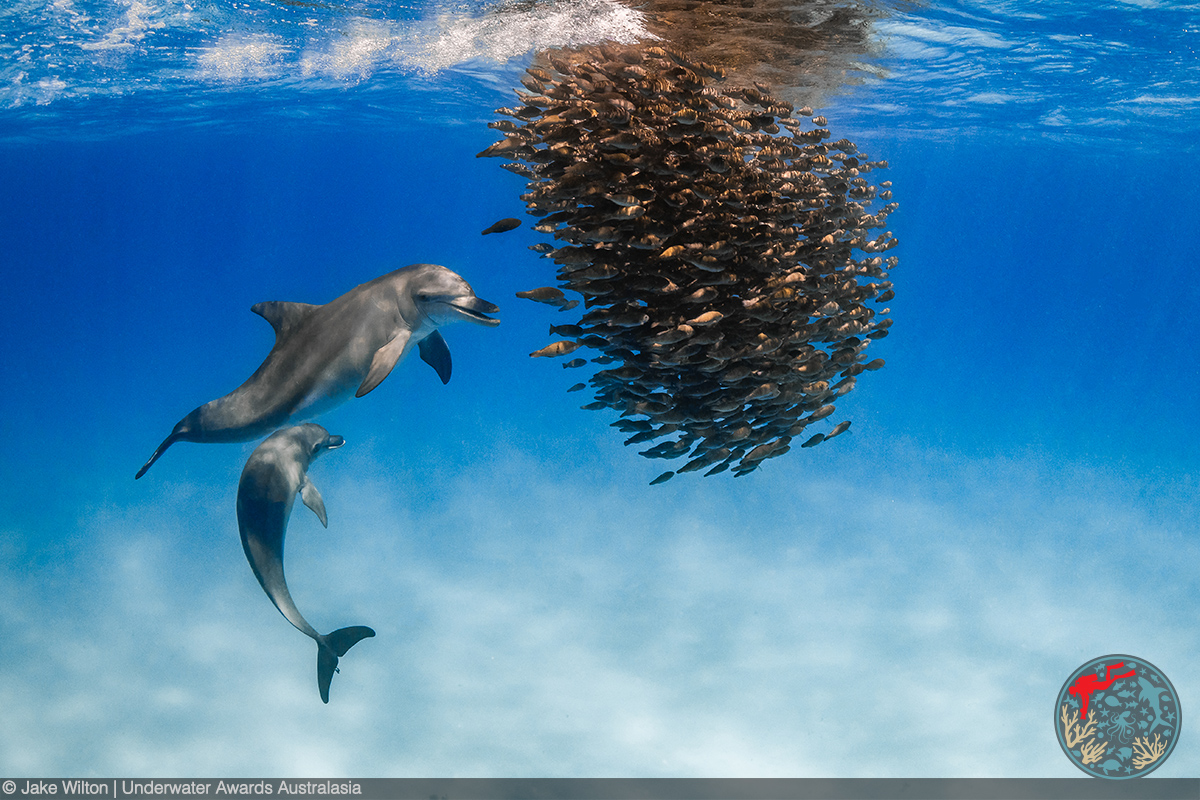
The story: Two bottlenose dolphins work together in coordinated motion to herd a tightly packed school of parrotfish. Captured in natural light, the scene reveals their intelligence and precision as they use speed, teamwork and the reef edge to corral their prey.
The parrotfish shift as one living mass, while the dolphins cut through the water with intent, demonstrating the complex hunting strategies that define life in the coastal waters of the reef. It was incredible to watch the dolphins herd the fish almost like a flock of sheep, gradually tightening the school before moving in to pick them off one by one.
Each member of the pod appeared to take a turn, while others maintained the formation and ensured the school remained tightly grouped. Watching this coordinated behaviour unfold offered a rare glimpse into the cooperation and strategy involved in their hunting. What initially appeared chaotic was remarkably organised, with each dolphin playing a role in keeping the fish together and maximising the success of the hunt.
Location: Ningaloo Reef, WA, Australia
Shot with: Nikon D810, Sigma 15mm f/2.8 Fisheye, Aquatech housing, natural light; f/9, 1/800s, ISO 320
Winner, Sydney Category
‘Dragon Clinger’, by Talia Greis, Australia

The story: A clingfish rides on the back of a weedy seadragon. Clingfish are considered the ‘clingers of the sea,’ and often attach themselves to rocks, kelp, reefs, and occasionally animals, using a suction disc formed from modified pelvic fins.
Their relationship with their host is purely commensal, using the host to travel and hide from predation. The weedy seadragon is such a beautiful, indigenous symbol of Australian culture and marine life. We often admire these incredible creatures without truly noticing the richness of their colours, the intricacy of their patterns, and the elegance of their shapes.
Without this moment of close attention, I wouldn’t have noticed the cheeky hitchhiker navigating the dots and lines of the seadragon’s body. On even closer inspection, you can also spot—though softened by depth of field—a tiny parasite riding on the back of the clingfish.
It is a profound reminder of the ocean’s intricate chain, and how every creature beneath the surface has its place and purpose.
Location: Kurnell, Sydney, NSW, Australia
Shot with: Sony A1, Sony FE 90mm f/2.8 Macro, Isotta housing, single Inon Z-330 strobe with Backscatter snoot; f/11, 1/200s, ISO 100
Winner, International Waters Category
‘Crowded Spotlight’, by Simone Caprodossi, Australia

The story: Every year, between November and February, whale sharks aggregate in the Gulf of Tadjoura in Djibouti. Over the past several years, I have been part of a scientific expedition to study the aggregation.
On most trips, once or twice we will witness a whale shark or two come to opportunistically feed on the plankton and small fish that concentrate under the boat lights at night. During our December 2025 trip, there appeared to be much lower levels of nutrients in the water than usual, and we hardly saw any sharks feeding at the surface during the day.
Possibly due to the scarcity of daytime feeding, the sharks appeared particularly committed to their nighttime meal under the boat lights. For the first time, we got to witness up to six sharks feeding at the same time, jostling for position in the narrow space under the lights.
It was very challenging to get a clear view of the sharks. Their huge bodies covered each other and cast very dark shadows, obscuring the already very limited light, and I was very pleased to capture four distinct individuals at different moments during their feeding frenzy.
Location: Gulf of Tadjoura, Djibouti
Shot with: Sony A7R Mark V, Sony FE 14mm f/1.8, Isotta housing, natural light; f/5.6, 1/80s, ISO 2000
Winner, Conservation Category
‘Trapped in the Blue’, by Annika Dahlberg, Australia
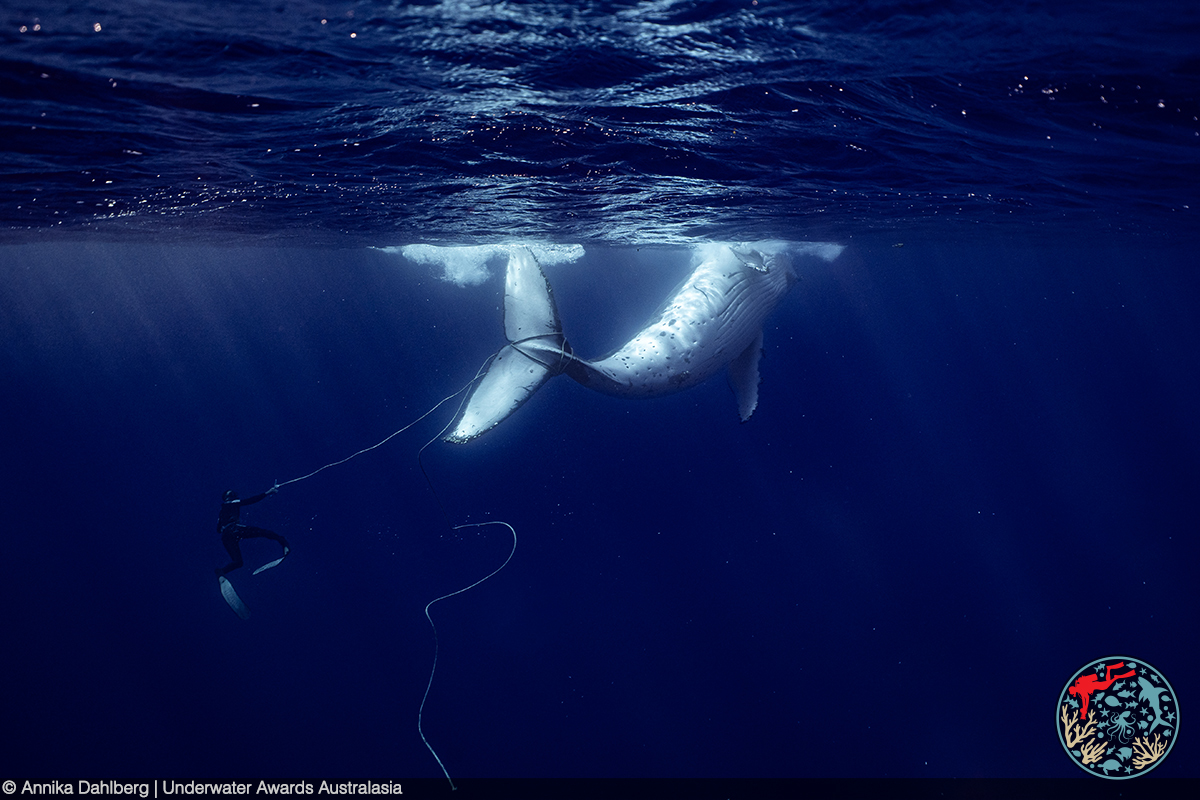
The story: Our whale-watching trip turned into something I had never expected to witness. As I entered the deep blue water, I was met by a shocking scene.
My worst fear had come true: a young humpback whale entangled in a thick rope, anchored to the ocean floor. The rope was wrapped around his fluke, and he had already been trapped for hours—and was tiring quickly.
With assistance from local authorities and great courage from a brave diver, the young male whale was eventually freed. It was a tough mission to free the whale, but it was accomplished by small teams working together and doing what we could for an animal in peril.
Location: Niue
Shot with: Sony A7 Mark III, Sony FE 16–35mm f/4, Seafrogs housing, natural light; f/6.3, 1/800s, ISO 800
Winner, Portfolio Category
‘The Invisible’, by Giacomo Marchione, Italy
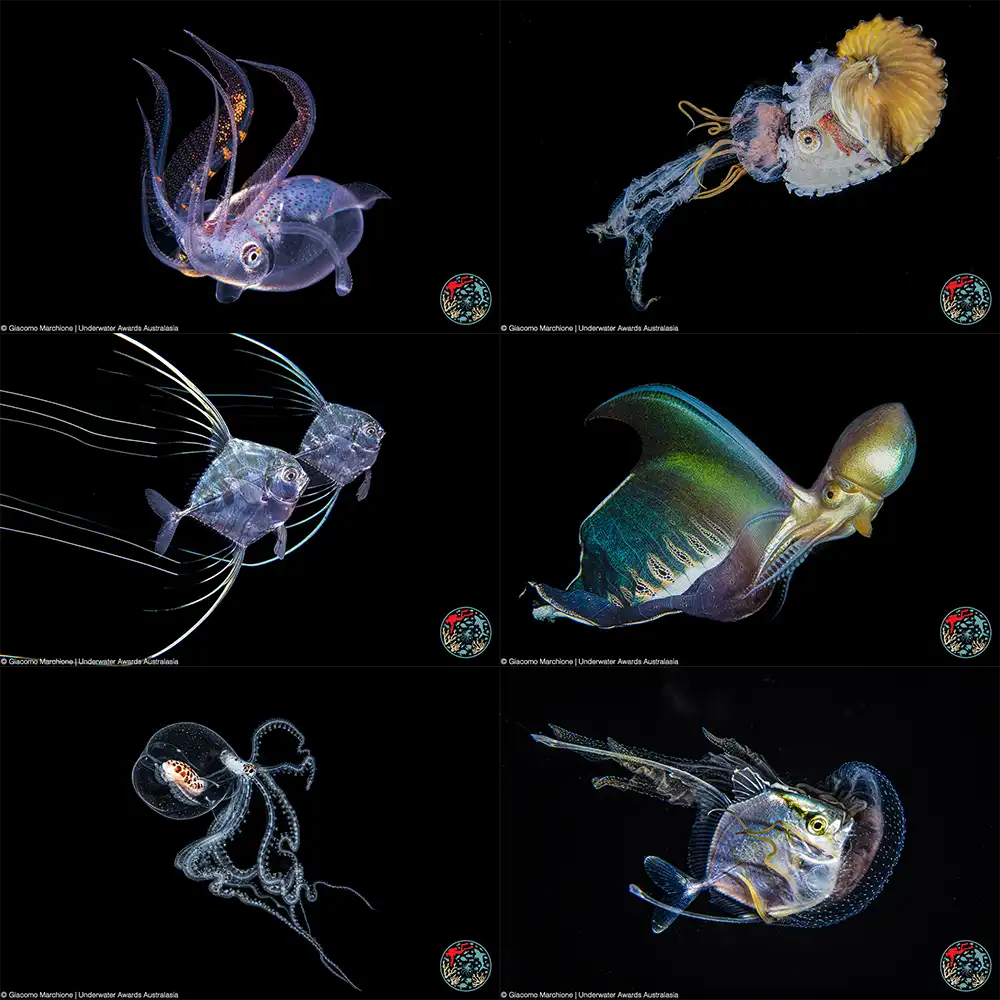
The story: At night, the ocean doesn’t sleep. When the sun sets and the sea seems to fall silent, one of nature’s most extraordinary spectacles begins: the vertical migration of plankton. Millions of organisms rise from the depths to the surface, and in this upward migration, it’s possible to photograph ‘the invisible’—that which cannot be photographed during the day.
Location: Anilao, Batangas, Philippines
Shot with: Nikon D850, Nikon AF-S 60mm f/2.8 Macro, Seacam housing, Seacam Seaflash 160D strobes; f/32, 1/200s, ISO 400
Winner, Tough TG Category
‘Anemone Tenant’, by Qian Kun, China
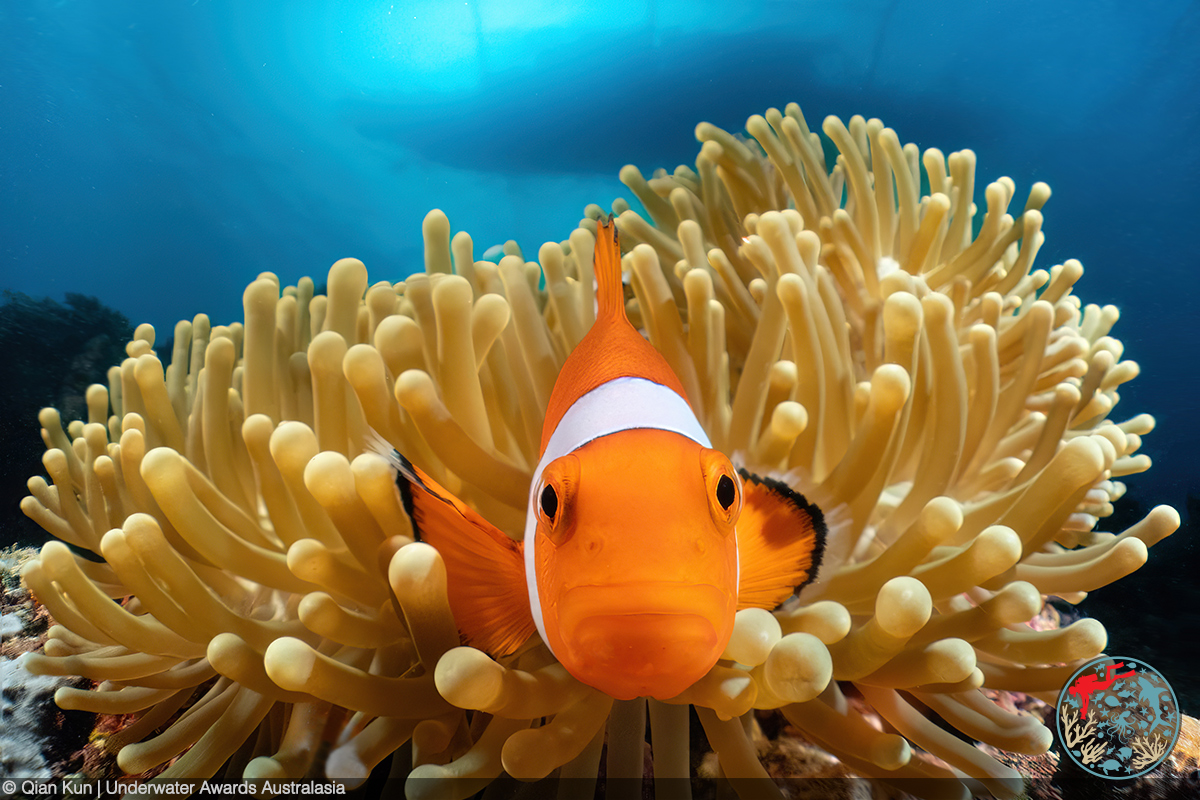
The story: Whenever I find an anemone hosting false percula clownfish, I check to see if they are spawning. The family in this anemone did indeed have eggs, but I did not wish to disturb them.
When clownfish are protecting their brood, they will drive away intruders. In this defensive state, they will swim forward and stare straight at the camera, a posture perfectly captured with a wide macro lens.
As I was setting up this shot, I noticed the dive shop’s boat anchored and drifting overhead, and I waited for nearly an hour to capture the composition I was after: the clownfish glaring at me, with the dive boat settled perfectly in the background.
Location: Romblon, Philippines
Shot with: OM System Tough TG-7, Olympus PT-059 housing, Inon UFL-M150 insect-eye lens, Backscatter Mini Flash 2; f/18, 1/100s, ISO 100
Winner, Smartphone/Action Cam Category
‘Halimeda Ghostpipe’, by Enrico Somogyi, Germany

The story: A Halimeda ghost pipefish perfectly camouflaged among lush reef algae, photographed using a smartphone with Nauticam’s ‘bugeye’ lens.
A diver positioned in the background served as a model, adding depth, scale, and a sense of adventure while keeping the ghost pipefish as the main subject. I approached slowly, maintained precise buoyancy, and carefully framed the composition without disturbing the environment.
The final shot captured the peaceful atmosphere and the beauty of marine biodiversity—and demonstrated that even a smartphone can produce impressive underwater images.
Location: Tulamben, Bali, Indonesia
Shot with: vivo X200 Pro using 85mm (equivalent) lens, Divevolk housing, Nauticam EMWL-1 with 160° Objective Lens, dual Weefine SmartFocus 2600 video lights; f/2.7, 1/160s, ISO 50
Winner, Only Water Category
‘The Best of Both Worlds’, by Tom Healy, Australia

The story: This image was taken at my favourite reef, just 15 minutes from where I grew up on the South Coast of New South Wales. The wave is a short heavy slab that breaks directly in front of a series of boulders, and reaching the lineup involves jumping from the edge of a rock ledge into the water.
This particular wave was photographed shortly after sunrise, when the low morning sun created a beautiful, warm backlit glow as it filtered through the wave. That time of day is my favourite to shoot this reef, when the light and water come together to create something a little more magical.
Location: South Coast, NSW, Australia
Shot with: Sony A7 Mark III, Sony FE 24–105mm f/4, Aquatech housing; f/5.6, 1/1250s, ISO 200
For more information and the complete listings of all winners and honourable mentions, head to UnderwaterAwards.com.
The post Weedy seadragon film wins Underwater Awards Australasia 2026 appeared first on DIVE Magazine.