
 Nöbetçi Eczaneler






Sometimes the most remarkable archaeological discoveries do not begin with an expedition. They begin with a dive.
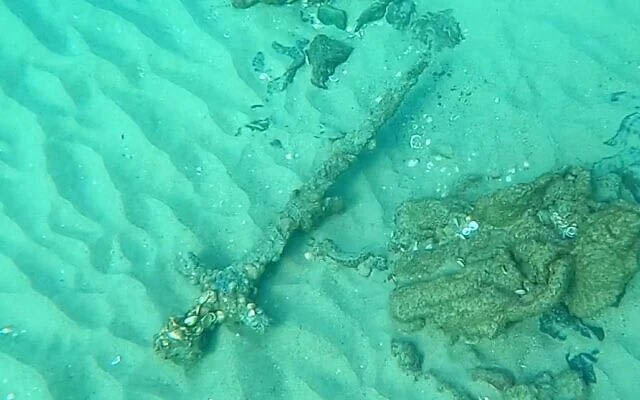
A medieval sword believed to date back around 900 years has been recovered from the seabed off Israel’s Mediterranean coast. But what makes the discovery especially intriguing is not just the weapon itself. It is the fact that the same diver has now found two Crusader swords in the same area of seabed.
The discovery was made by maritime archaeology student Shlomi Katzin, who spotted the heavily encrusted weapon while diving near Dor Beach, south of Haifa. Covered in shells, marine growth, and compacted sand, the sword had spent centuries hidden beneath the Mediterranean before being recovered under the supervision of the Israel Antiquities Authority.
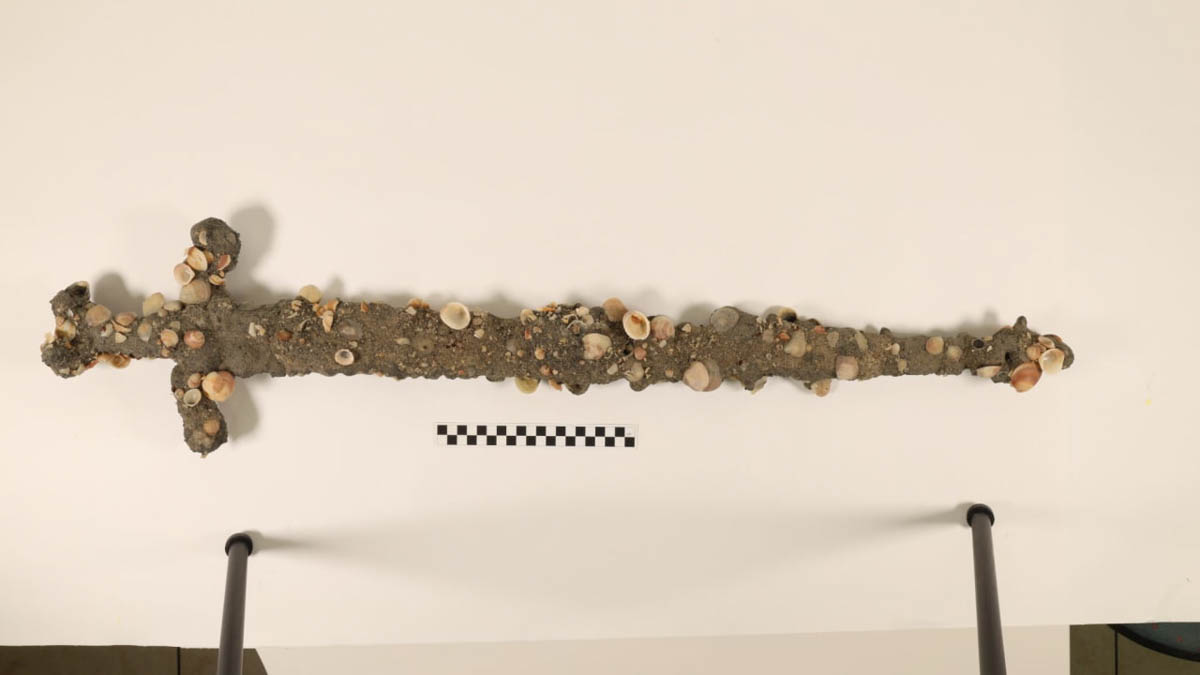
(photo credit: Yoav Bornstein, University of Haifa)
The weapon is roughly a metre long and appears to be a single-handed knight’s sword, the type commonly carried by Crusader warriors during the medieval conflicts that shaped the eastern Mediterranean.
Using modern imaging techniques, researchers examined the object with CT scanning to understand its structure without damaging the fragile corrosion layer. Archaeologists believe the blade was likely forged in Europe before making its way to the Levant during the Crusades.
What has researchers particularly interested is the location.
Katzin discovered another Crusader sword in the same coastal region several years ago, suggesting the area may have been an important medieval anchorage or harbour where ships sheltered from storms. If vessels carrying Crusader soldiers anchored there, it is possible weapons, armour, and other objects were lost during rough seas, battles, or shipwrecks.
For underwater archaeologists, that possibility opens an intriguing question.
If two medieval swords have emerged from the same stretch of seabed, what else might still be buried beneath the sand?
According to the Israel Antiquities Authority, weapons like these were valuable personal possessions that knights rarely discarded. Their presence underwater usually points to a moment of chaos. A lost weapon during combat, a shipwreck, or a hurried escape.
In other words, the seabed may be preserving fragments of history tied to the turbulent centuries of the Crusader states that once dominated parts of the eastern Mediterranean.
For divers, discoveries like this highlight how much of history still lies hidden beneath the water.
While large shipwrecks often capture headlines, countless smaller artefacts remain scattered across the seabed. Anchors, ceramics, weapons, and tools can survive centuries underwater, slowly becoming part of the marine landscape until chance brings them back to the surface.
The Mediterranean in particular is one of the richest underwater archaeological regions on Earth. Trade routes, naval battles, and maritime commerce have been shaping the region for thousands of years, leaving behind layers of history waiting to be discovered.
And sometimes, all it takes is the sharp eye of a diver.
With two Crusader swords already recovered from the same waters, archaeologists may now begin looking more closely at the surrounding seabed. If the area once served as a medieval anchorage, the chances are high that more artefacts remain hidden beneath the sand and seagrass.
For the diving world, it is another reminder that beneath familiar dive sites, history can still be waiting quietly for someone to notice.
THE SCUBA NEWS Link !
DemirHindiSG 14 Mart 2026-00:17