
 Nöbetçi Eczaneler




The ocean keeps its greatest mysteries far below the reach of sunlight. In the deep scattering layers and abyssal plains, life evolves in near total darkness, under immense pressure, and often in extreme scarcity. The creatures that thrive here are not just rare, they are adapted to avoid detection. Some exist in extraordinarily low densities, others migrate vertically under cover of darkness, and many have only been properly documented thanks to advances in deep-sea exploration technology.
For divers, photographers, and ocean enthusiasts, these animals sit at the intersection of science and myth. While most will never be encountered at recreational depths, understanding where they live and how scientists locate them brings those rare sightings into sharper focus.
Why deep-sea animals are so difficult to find
Below roughly 200 metres, light drops away rapidly and the ocean enters the mesopelagic zone, followed by the bathypelagic and abyssal regions. Food is scarce, pressure is extreme, and movement costs energy. As a result, many deep-sea animals are solitary, slow-moving, and highly efficient.
Much of what is known about these environments comes from the work of the Monterey Bay Aquarium Research Institute, whose long-running deep-sea ROV programme has revealed previously unseen behaviours, species interactions, and entire ecosystems that trawls and strandings could never explain.
Giant squid, the original deep-sea legend
The giant squid, Architeuthis dux, was once known almost entirely from damaged specimens recovered by fisheries or found stranded after storms. Live sightings were considered folklore until baited camera systems finally captured the species behaving naturally at depth.
Confirmed observations have come from deep deployments supported by NOAA Ocean Exploration, showing that giant squid are cautious, investigative animals drawn to slow-moving bait rather than aggressive hunters, with encounters typically occurring well below 500 metres.
For anyone hoping to see a giant squid, participation in deep-water research projects or expeditions deploying baited cameras is the only realistic route.
Colossal squid, ruler of the Southern Ocean
Heavier and more powerful than the giant squid, the colossal squid (Mesonychoteuthis hamiltoni) inhabits the cold depths of the Southern Ocean. For decades, knowledge of the species came almost entirely from fragments found in sperm whale stomachs.
That changed when expeditions supported by the Schmidt Ocean Institute captured the first confirmed footage of a live juvenile using deep-sea remotely operated vehicles near Antarctica, validating long-standing assumptions about habitat depth and behaviour.
Encounters with colossal squid remain limited to polar research voyages using advanced ROV technology.
Vampire squid, survivor of oxygen-poor waters
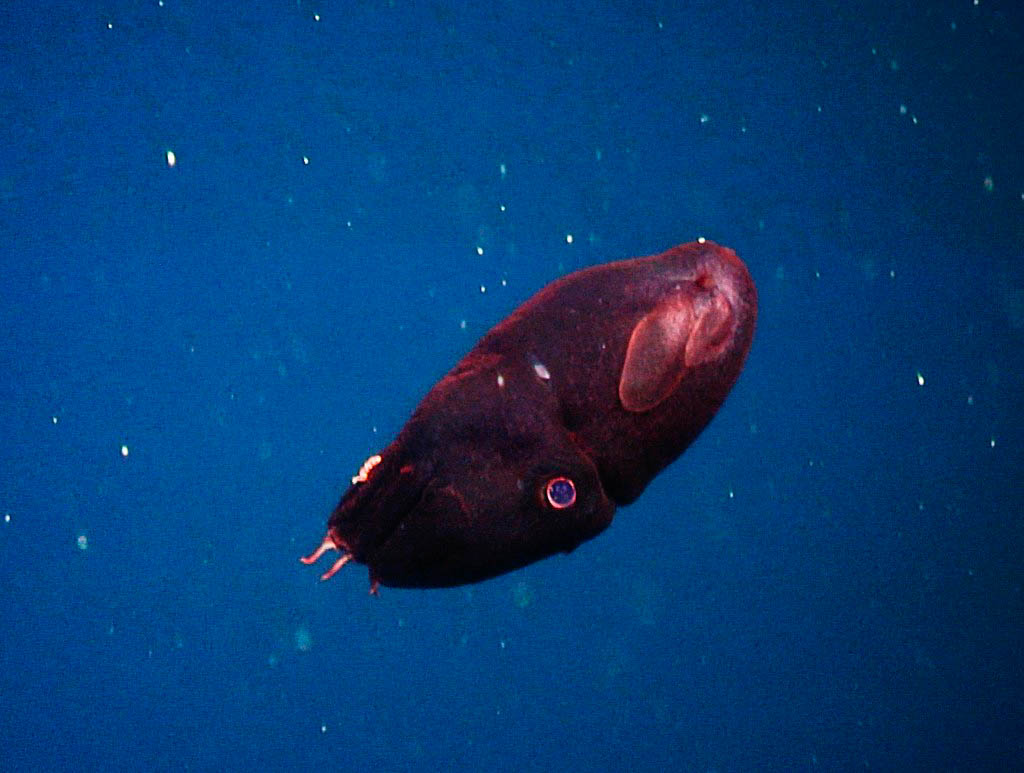
Despite its name, the vampire squid (Vampyroteuthis infernalis) is neither a squid nor aggressive. It occupies oxygen minimum zones where most predators struggle to function.
Research combining deep-sea video and biological analysis, including work curated by the Natural History Museum, has shown that vampire squid feed on drifting organic material rather than active prey, conserving energy in an environment where every movement matters.
Sightings occur almost exclusively during slow ROV surveys using low-intensity lighting, as bright illumination disrupts natural behaviour.
Wm. Leo Smith, Public domain, via Wikimedia Commons
Oarfish, the deep ocean’s messenger
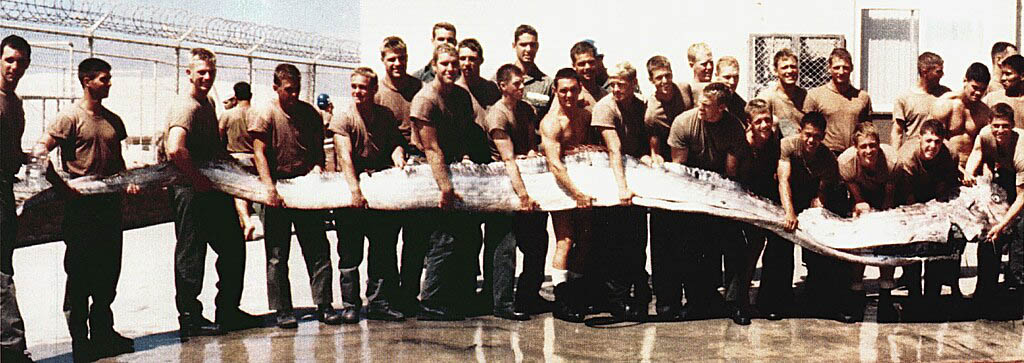
The oarfish (Regalecus glesne) is the longest bony fish in the ocean, yet remains poorly understood. Most sightings occur when individuals appear near the surface, often injured or dying, which has fuelled myths for centuries.
Live oarfish have been documented at depth during surveys conducted through the SERPENT Project, where ROV footage shows them hovering vertically in open water, calm and largely motionless, suggesting a life spent far from reefs or coastlines.
For divers, encounters are entirely opportunistic and typically linked to unusual oceanographic conditions rather than deliberate searches.
Goblin shark, a living fossil
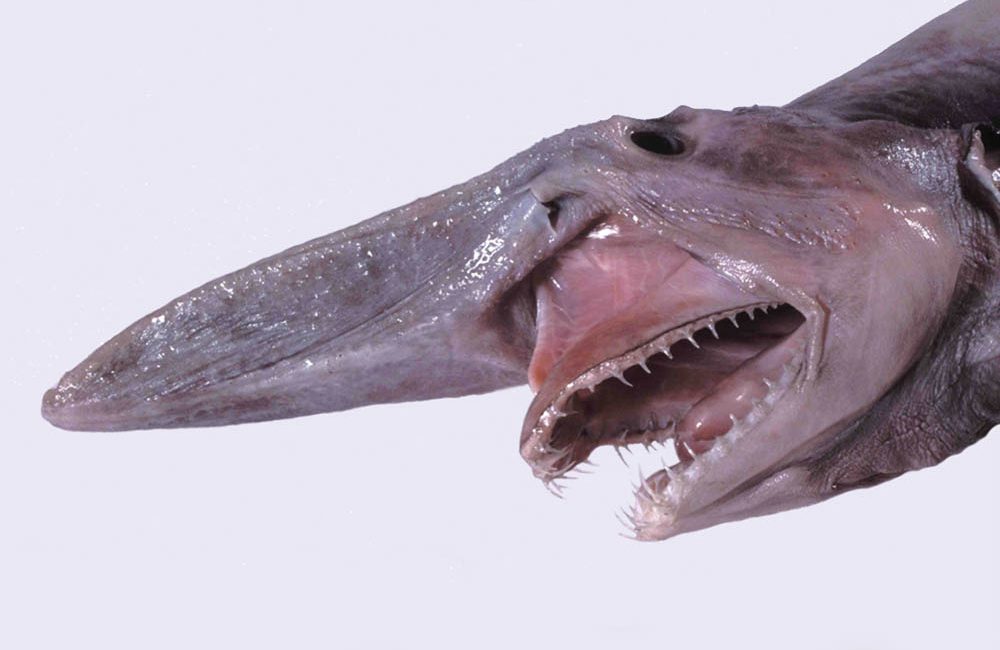
The goblin shark (Mitsukurina owstoni) is a deep-water species instantly recognisable by its elongated snout and protrusible jaws. Most records come from deep trawl or longline bycatch.
Distribution data curated by the Florida Museum of Natural History indicates a global but patchy presence along continental slopes, with very few confirmed in-situ observations.
How scientists actually find elusive deep-sea animals
Deep-sea discoveries are rarely accidental. Researchers rely on baited remote camera systems to attract scavengers and large predators, while slow-moving ROVs equipped with sensitive low-light cameras reduce disturbance and extend observation time.
Many elusive species also take part in diel vertical migration, rising hundreds of metres at night to feed before returning to the depths. This behaviour explains why deep-origin animals occasionally appear during night dives, blackwater photography sessions, or after major oceanographic events.
Ethics and responsible observation
The deep ocean is one of the least resilient ecosystems on Earth. Excessive lighting, aggressive baiting, or physical interaction can alter behaviour or cause harm. Responsible observation prioritises documentation over disturbance and follows strict scientific protocols.
Credible sightings include depth data, timestamps, and contextual imagery, allowing records to be verified and incorporated into long-term research rather than dismissed as anecdotal.
What this means for divers and photographers
For most divers, true deep-sea species remain out of reach. However, night diving, blackwater photography, and collaboration with research initiatives offer opportunities to observe deep-origin animals during migration or early life stages.
Those determined to encounter the ocean’s most elusive giants should look toward science-led expeditions rather than tourism. The reward is not just a sighting, but the opportunity to contribute to genuine scientific understanding.
Final thought
The deep ocean is not empty, it is simply hidden. Each expedition pushes back the boundary between myth and evidence, revealing animals that challenge everything we think we know about life on Earth. With patience, technology, and restraint, the ocean’s most elusive inhabitants are slowly coming into view.
THE SCUBA NEWS Link !
DemirHindiSG 17 Aralık 2025-17:27

.jpg)
